
Double-Deep Design Tips for Your Carolina Warehouse!

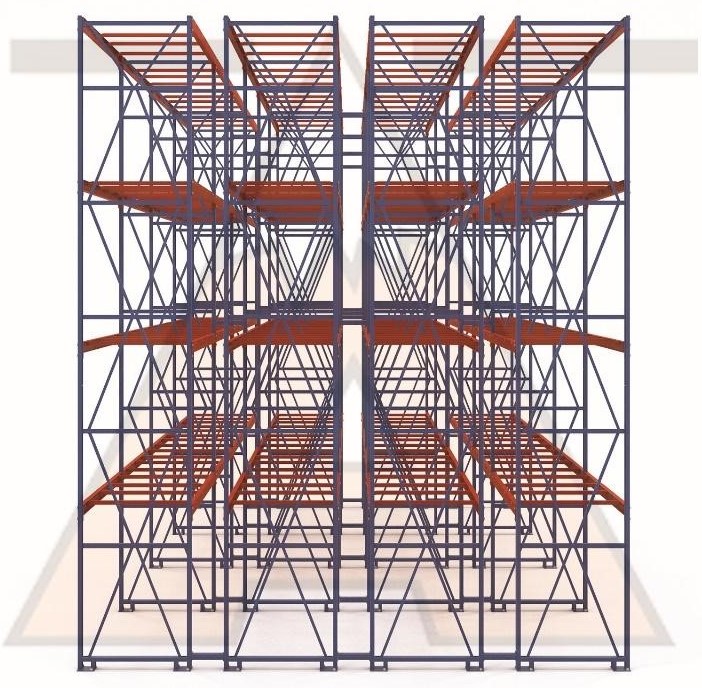
Double-Deep Selective Pallet Rack, a two-deep version of standard selective pallet rack, is an efficient solution for doubling pallet storage density. This system maximizes your warehouse space by reducing dedicated aisle space. It is an ideal system for high-volume SKUs.
One consideration of a double-deep (also called deep-reach) pallet rack system is that it requires a deep-reach forklift and a proper turn radius for that vehicle. Consult with your local Apex Carolina team to design a storage solution expertly tailored to your needs.
Double-Deep Pallet Rack Overview
Pros:
- Optimized warehouse space with reduced aisles
- More pallet positions in the same amount of space
- Low maintenance
- User-friendly design
Cons:
- Reduced selectivity vs. standard selective
- Reduced utilization percentage
- Requires specialized equipment – deep-reach truck
What’s Unique About Deep-Reach Forklifts?
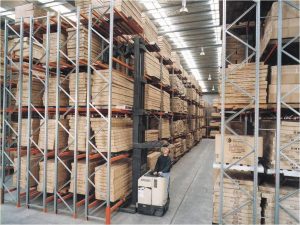
 Deep-reach forklifts must extend vertically and horizontally when accessing a two-deep rack system. The pantograph is the scissor-like mechanism attached to the forks that enables the deep reach into the racking system to load and extract pallets. However, anyone who has extended themselves up and over to reach something understands that it takes quite a bit of balance to stay upright. In this case, it’s crucial that the vehicle remain stable as the forks are extended… and that is the job of the outriggers.
The outriggers are like two outer legs used to distribute the load weight. These stabilizing mechanisms will have one or two wheels that roll as the vehicle moves. The distance between the outriggers accounts for the base leg opening (BLO), which adjusts from narrow to wide. BLO set wide may extend outside the pallet width, while set narrow would slide underneath the pallet. Consequently, the rack design must be adaptable to accommodate either a wide or narrow outrigger clearance. This entails ensuring the rack has a suitable bottom beam or sufficient width to accommodate the outriggers, allowing them to maneuver around pallets positioned on the floor.
Deep-Reach Forklifts and Outrigger Spacing
Design Considerations
Outrigger size and spacing vary based on the forklift model and manufacturer. When designing your system, review manufacturer guidelines for accurate details. However, as a general guideline, a standard GMA-style pallet of 48” deep x 40” wide may have an inside dimension of 42” and an out-to-out span of 53½” of the outriggers.
There are 3 application options:
- Add a bottom beam rather than placing pallets on the ground.
- Expand the bay opening to provide clearance left-to-right for pallets on the floor.
- Use a recessed front column
1. Add A Bottom Beam
Maintaining a standard bay opening of 96” in a double-deep reach application offers ergonomic flexibility that can maximize warehouse space and footprint. Though increasing the bay opening to 102” can eliminate the need for a bottom beam, be sure to consider a bottom load beam (shown right) for pallets to ensure proper side shift attachment for load positioning without truck movement.
2. Expanded Bay Opening
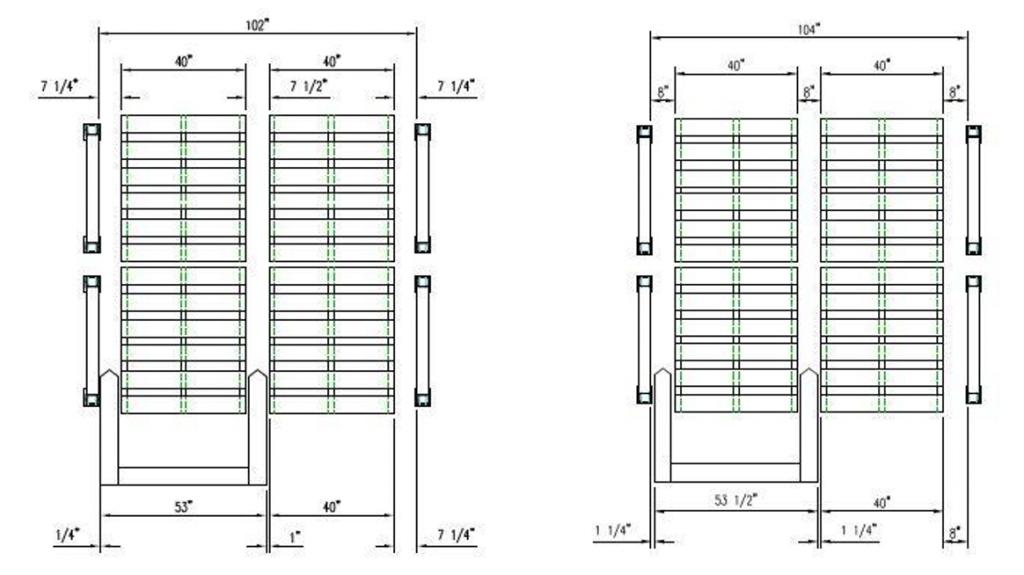
Expanding the bay opening to 102” or 104” can supply more space between pallets and outriggers, as illustrated above. In many cases, this design option removes the necessity of a bottom beam, enhancing left-to-right clearance. Some cases may still require the beam, such as food production.
3. Recessed Column Design

Pallet rack configurations can have a recessed front column. This offers more room for forklift outriggers and a broader turning radius. There are three common column designs, each with its own advantages and considerations:
- Offset/Cant Leg Upright: Sharp recessed front post angled back at 90° towards or connected to the rear post for outrigger clearance while accommodating lower beam levels as low as 6”.
- Slope Leg Upright: The front column slopes toward the rear column to facilitate fork truck clearance. Angling depends on rack dimensions and upright capacity requirements. These are often known to create more room for the fork truck as they maneuver around the system.
- Raised I-Beam: To make additional space for the outriggers, this design elevates the product off the floor by removing the front column. However, it has its pros and cons:
-
Design Pros
- Continuous load-bearing pallet support
- Enhanced abuse resistance in the horizontal direction from all three beams
- Standard rack components above the base
- Bottom beam removal for floor storage
-
Design Cons
- Frame design is limited to double-deep application
- Higher floor-loading compared to stacked I-Beam base
- Reduced vertical clearance on each level by 1”
- Potential debris accumulation at the base
-

Choosing the right design for your double-deep selective pallet rack is vital. The Apex engineering and design team is ready to assist you in configuring the ideal system for your space, equipment, budget, and order fulfillment needs. Call us today for expert guidance tailored toward your North or South Carolina Operation!
