
7 Signs ASRS Systems Can Solve Your Warehouse Challenges

Are the Signals Clear? ASRS Could be the Warehouse Automation Solution You Need
Some signs are universally recognized– like a car on the side of the road – hazards blinking, the trunk open, and a stressed-out traveler with a spare tire. You don’t need to know more than to recognize that problem… and the solution. If only all challenges were that easy to diagnose and treat. Warehouse customers – can you relate? Good news for you – We CAN look at common signs that trigger a problem, and we’ll even give you the solution. The seven warehouse conditions outlined below are all relatively common, and automated storage and retrieval systems (ASRS Systems) can address all viably and economically.
Don’t get caught up in believing that warehouse automation is only for large operations or is too costly to pay for itself. With space, labor, and efficiency savings, ASRS systems deliver an ROI between 18 months – 5 years (depending on system size and complexity). With a life span of 20-25 years, that’s a wise investment! Let’s dig in.
Do You Recognize These Challenges in Your Facility?
- Rising labor costs – labor is typically the most significant cost (upwards of 65% of operating costs on average). Repetitive tasks lifting heavy items or working in cold temperatures on stand-up forklifts at high rack heights can wear out the workforce.
- Warehouse space constraints – increasing SKU volume or product lines, increasing inventories, buffer stock, or consolidating facilities to streamline costs, or simply out-of-space operating at high (90+%) space utilization
- Mispicks & fill rate challenges – increasing restocking or stock-out scenarios, customer complaints, or loss of business
- Extreme warehouse climates – struggling to manage rising energy costs and meet new regulations while protecting workers from too-hot or too-cold conditions
- Inventory control – failing to keep up with stock rotation to minimize dead stock, monitoring loss prevention, plus tracking SKU demand to quickly adjust to satisfy customers
- Flexibility – facing space and personnel constraints due to increased sick days and the need for more space between workers
- Safety – workers are required to access dangerous heights and work in uncomfortable temperatures or tight spaces
Chances are that you’ve experienced at least some, if not all, of these challenges in your facility –you are not alone. This is precisely why many facility managers are exploring, integrating, or upgrading existing automated storage and retrieval systems.
Industries Adopting ASRS Warehouse Automation Solutions
|
|
Ten Benefits of ASRS Systems
The most significant benefit of the many benefits of an ASRS system is space optimization. Systems can be constructed to heights over 100’ tall with very narrow aisle designs that effectively use cube space while maximizing storage capacity. However, the upsides don’t end there. Automated storage and retrieval systems go to greater heights to deliver cost-effective operations.
- Save upwards of 40% of the space vs. standard racking with the same capacity
- Reduces labor costs – leverage workers for value-added, skilled activities
- Increase throughput rates – continuous workflow, automate repetitive tasks
- Attain 99% pick accuracy rates – happier customers, less waste, minimal restocking
- Control material flow – order picking, palletizing/depalletizing, and incoming/outgoing item handling
- Achieve energy savings – lights-out operation, more efficient heating, air-conditioning, or refrigeration
- Eliminate carbon-emitting vehicles – safer working conditions & prevent forklift strikes
- Improved worker safety – reduced strain & back injuries and worker’s compensation claims
- Improve dock efficiency – minimize waiting time for loading/unloading
- Prevent inventory damage – safer item handling reduces costs and waste
ASRS Systems Design Options
Just like your pallet racking or other warehouse systems, your ASRS system is custom-configured to meet the needs of your warehouse. Systems are scalable and modular, with the ability to handle a variety of items. To ensure your system is tailored to your precise needs, a thorough data analysis of your inventory should include:
What Goes Into ASRS Design?
- Order profile analysis
- SKU profile analysis
- Inventory profile levels
- Existing layout review
- Existing operational process and technology evaluation
From there, the evaluation continues to determine the available space, labor, and equipment resources to help define the best system for your needs. When talking about automated storage and retrieval, there are several types of systems to consider.
ASRS Configurations
- Automated Shuttle Systems
- Pallet & Unit-load ASRS
- Mini-load ASRS (Tote or Case Shuttle Systems)
- Horizontal & Vertical carousels
- Vertical Lift Modules
- Robotic Cube/Pod Storage

Apex Peak Shuttle
1. Shuttle systems – use automated shuttles to ferry pallets, cases, totes, or trays within a high-density rack structure. Shuttles can access single levels, or with the help of vertical lifts, robots or elevators can access multiple levels. Systems range from semi to fully automated depending on the need.
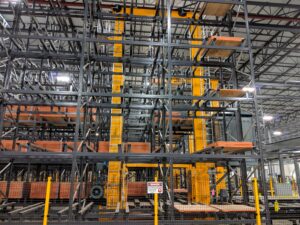 Pallet & Unit Load ASRS |
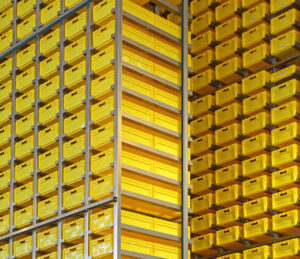 Mini-Load ASRS |
2. Pallet & Unit-Load ASRS – store and retrieve palletized inventory, pallet-sized items, and heavy cases with load weights between 1,000 – 3,500 lbs. Unit load systems have a high-density, narrow aisle footprint and offer quick storage & retrieval through either a fixed aisle crane (one crane per aisle) or movable crane (aisle-to-aisle) design at rates in excess of 70+ pallets per hour per crane.
3. Mini-load ASRS – tailored to lighter loads, typically 75 lbs or less often in totes, cartons, or trays. These systems are ideal for consolidated storage and efficient access to a wide volume of items.
4. Horizontal & vertical carousels – consolidate storage for a high volume of small items or parts stored bins within open rotating racking. Carousels present the bin to the picker for selection and, coupled with pick and put wall lights, can achieve 280+ pick lines per hour. Horizontal carousels are ideal for low-level ceiling height areas or under/over mezzanines.
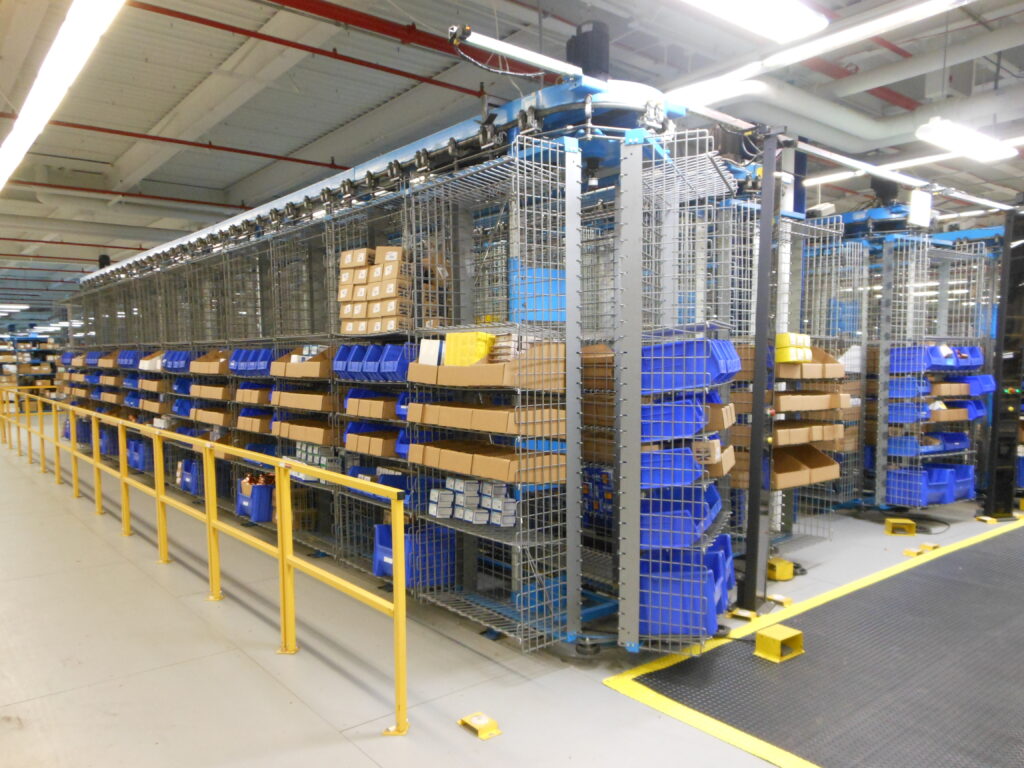
Horizontal Carousel
5. Vertical lift Modules– similar to vertical carousels, but these units are enclosed with access via a single opening that can be secured with limited, trackable access. Laser pointer technology and putwall lights can enable pick rates over 205 per hour.
6. Robotic Pod/Cube Storage – robotic system operating as a goods-to-person solution –robot picks up a storage pod or cube and delivers it to a workstation, then returns it once the selection is completed.
 Vertical Lift Modules |
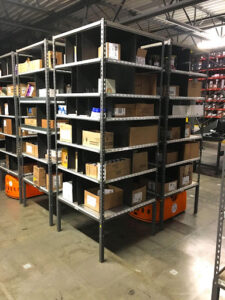 Robotic Pod/Cube Storage |
Customize Your Warehouse Automation Solution with the Apex Team

Now for your homework assignment – take a good look at those warehouse challenges at the beginning of the article. Is your facility facing some or possibly all of these conditions? If so, now could be the time to consider an ASRS system. The ideal place to start is with a call to the Apex Automation team, where we’ll provide an expert evaluation of your operation to make a sure determination and identify a tailored solution –Apex Automation is your go-to team.
Apex offers a full-service approach to solving your warehousing challenges whether or not we recommend an automation solution. Whatever the evaluation outcome, the Apex team is with you at each step of the process.
Call our automation specialists for a free consultation and schedule an on-site visit.
