
Pallet Rack Honeycombing – 7 Tips to Avoid this Sticky Storage Situation

No Vacancies – Maximize Your Storage Rack Effectiveness & Prevent Pallet Rack Honeycombing
Admittedly, the material handling industry uses some interesting terms (check out our glossary if you don’t believe us). One of those more perplexing terms you may hear is the “honeycombing effect.” If you’re unfamiliar with this phrase, honeycombing refers to the inefficient use of storage racking, resulting in unused or partially filled slots… resembling a honeycomb’s empty cells. Not only does honeycombing lead to the loss of valuable storage capacity, it can compromise the structural integrity of the pallet rack system, posing an unexpected warehouse safety hazard. Fear not– the following tips and strategies will help you minimize the risk of honeycombing in your storage rack solution.
What Conditions Create a Honeycomb Effect?
The design of your pallet rack system must complement your inventory specs, volume, and turn rates. That’s why there’s a range of storage system designs you can choose from to best optimize space while creating the most efficient flow of goods. When there is a mismatch of pallet rack configuration and inventory mix, however, your likelihood of creating the honeycombing effect increases. Scenarios that can generate that mismatch include the following:
Randomized stock placement: Lack of a well-defined slotting strategy can lead to wasted space and gaps between items, contributing to the honeycombing effect. Honeycombing is often challenging in high-density storage systems (e.g., drive-in, pallet flow, and push-back pallet rack) since those systems designate SKU lanes from 2-20 pallets deep, depending on the design. Your inventory volume must keep a majority of those slots filled most of the time to justify the value of the rack system and prevent inefficiencies in storage utilization, labor, and order fulfillment. Mixing SKUs in the same lane to “fill up slots” is not a viable alternative, so those slots simply remain empty unless the system is reconfigured.
|
Drive-in is particularly susceptible to the pallet rack honeycombing effect for several reasons. Drive-in designates each vertical lane to a single SKU; therefore, an eight-pallet deep, four-level high system would have 32 pallet positions per lane – all one SKU. However, what if your inventory is greater or less than the available pallet positions? Too Many Pallets – If you have more pallets than a single lane can hold, you’d consider using a second lane. However, depending on the overage amount, you may be leaving a high percentage of that 2nd lane empty, which is inefficient. More likely, you will need to floor stack or find an alternative rack to house those pallets. Depending on how many SKUs this affects and to what extent, this could become a significant issue to tackle. Too Few Pallets – Similarly, when inventory falls significantly under the number of pallet slots your drive-in rack lanes will have perpetually open spots. Unlike pallet flow and push-back rack, you cannot store pallets of varying SKUs by lane in a drive-in system because of the way that drive-in must be loaded and unloaded. Drive-In is loaded starting with the last (or furthest) location on the floor level, then working up to the higher levels, always from BACK to FRONT until the lane is full. However, drive-in is unloaded in reverse, starting from the front of the upper levels and then down and back. This is not an arbitrary method; it is required for the stability of the system. Storing different SKUs per lane or on various levels would create an order fulfillment and accuracy headache. |
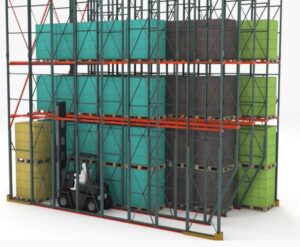 Example: Honeycombing Effect in Drive-In Pallet Rack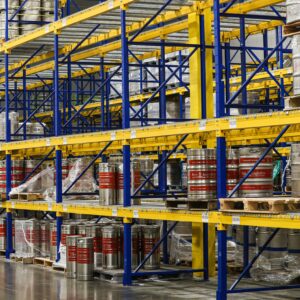
Inadequate inventory rotation: If goods are not rotated regularly, older stock can remain in the rack for extended periods, leaving empty spaces around it as newer stock is placed elsewhere, leading to honeycombing.
Irregular or small-sized inventory: Storing small pallets or non-palletized stock in pallet racking designed for standard GMA-style pallets can result in unevenly filled spaces, leaving voids between pallets and causing honeycombing. Additionally, palletizing errors that result in stock overhanging the pallet will create a scenario where fewer than expected pallets can be loaded into that lane or slot.
Inaccurate forecasting and planning: Poor inventory forecasting can lead to insufficient or excessive stock levels, contributing to honeycombing issues.
How Large is Your Honeycomb?

Much like that hornet’s nest in your yard… the bigger the honeycomb, the more you want to mitigate the risk. While no pallet rack system is 100% filled 100% of the time, it’s worth monitoring the percentage of open pallet rack space in your storage systems.
Calculate:
A – What is your total capacity?
B – What is your fill number?
Subtract B from A to get C.
Divide C by A and multiply 100 to obtain the percent of open slots.
E.g., 1,000 potential storage slots with 750 filled leaves 250 empty resulting in a 25% open rate. Depending on the size of your operation, a honeycombing effect of 25% could be enough to cause an increase in the price of inventory handling.
7 Steps to Take to Combat Honeycombing Excess in Your Pallet Rack
Minimizing the risk of honeycombing in a storage rack system is essential for maximizing storage efficiency and maintaining a safe warehouse environment. Often, the best solution is to use a mix of racking solutions based on the product mix. Apex can help determine the best solutions through a data study.
Here are a few practical tips to help achieve your goals:
1. Effective inventory management: This is the most effective tool for optimizing your storage capacity. WMS systems are often deployed to implement your slotting plan and achieve turn rates. Additionally, regular inventory audits, tracking of stock movement, and accurate forecasting will help maintain optimal stock levels and ensure timely inventory rotation to minimize the chances of overstocking or understocking and reduce the potential for honeycombing.
2. Right-size your pallet rack systems: Organize the placement of pallets or items in the storage racks according to size, shape, and turnover rate. Group similar items together and keep frequently accessed goods within easy reach to avoid creating empty spaces due to inconsistent storage. Periodically review your capacity effectiveness to identify and address any honeycombing issues. Make adjustments based on inventory changes and storage requirements to optimize space utilization.
Check out the Apex Matrix to help identify rack systems that most effectively meet your stock needs. Call our team for expert design and engineering support.
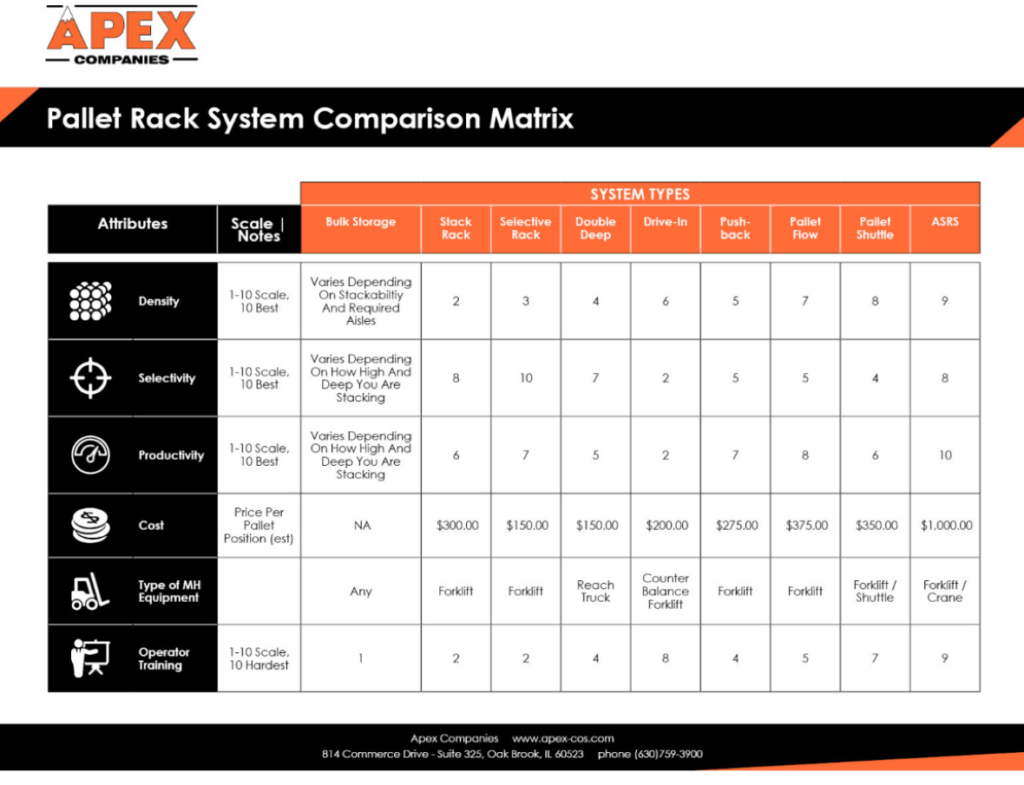
3. Use rack labels and markings: Clearly label rack locations and provide instructions for pallet placement. This ensures uniformity in storage practices and helps warehouse staff utilize space more efficiently, reducing the risk of honeycombing.
4. Maintain a consistent stock rotation: encourages the continuous flow of goods and minimizes the chances of items being left unused for extended periods, reducing honeycombing.
5. Train warehouse staff: Properly train your warehouse staff on best storage and inventory management practices. Educate them about avoiding honeycombing and maintaining an organized warehouse to promote better space utilization.
6. Safety and load capacity awareness: Ensure that all staff members are aware of the load capacities of each rack and the importance of adhering to weight limits. Overloading racks can lead to uneven storage and honeycombing, as some areas may be underused to compensate for overloaded sections.
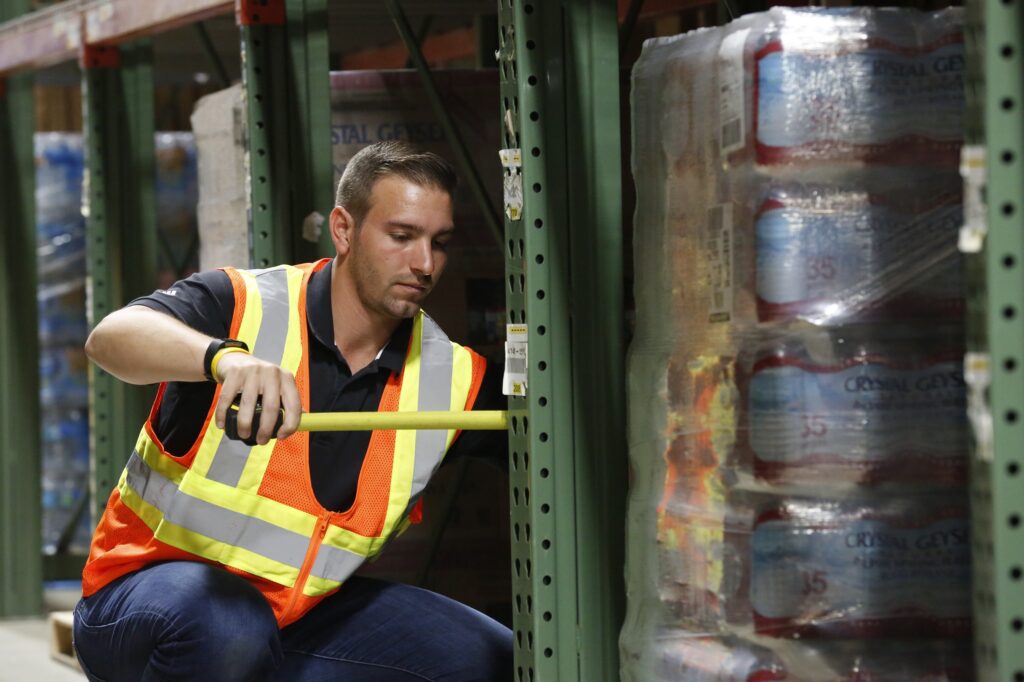
7. Regular rack inspections: Conduct scheduled pallet rack inspections to identify damage that can risk the system’s structural integrity and ensure that all available storage slots are safe for optimized use.
These tips will help you effectively minimize the risk of honeycombing in your storage rack system and create a more efficient and safer warehouse environment for your personnel and inventory. If you need any help along the way, the Apex team has you covered. Our design, engineering, automation, project management, installation, and rack inspection and repair teams are at the ready. Call today to speak with our warehousing experts.
