
7 Tips to Minimize Costly Inventory Shrinkage

Actionable Tips to Prevent Inventory Shrinkage & Improve Warehouse Safety
Warehouse shrinkage is not a small matter. In fact, it can impose a significant financial burden on a warehousing or distribution center operation. Since shrinkage can occur at different stages of the process -from receiving to storage, picking, packing, and shipping, it’s essential to take a holistic approach to combat the challenge. The tips outlined below will mitigate shrinkage rates and, as a bonus, improve warehouse safety –they are practical, easy to implement, and ultimately cost-saving.
What is Warehouse Shrinkage?
Since you can’t fix a problem you can’t define– shrinkage refers to the loss of inventory or goods within a warehouse or distribution center that cannot be accounted for through sales or other legitimate reasons. Shrinkage can be caused by various factors such as theft, damage, errors in inventory control, administrative errors, and even employee dishonesty, and is often used as a measure of the effectiveness of a business’s inventory control system.
Besides the financial burden that missing or damaged inventory can do to your bottom line, shrinkage also negatively affects your customers with stock miscounts, unfulfilled orders, and shipping delays.
How Common is Shrinkage?
While it’s impossible to ensure that a piece of inventory will never be damaged or misplaced in your facility, for the reasons outlined above, it’s in everyone’s best interest to get your shrinkage rate as low as possible. For e-commerce operations, an acceptable rate can be between 1.5% – 2%, but each business has its profit/loss targets. According to WERC (Warehouse Education and Research Council), a shrinkage rate above 0.46% is a serious concern.
Let’s address the issue before it becomes a serious concern.
How Does Shrinkage Occur?
While every facility is unique, several common activities can put your inventory at risk of being lost, damaged, or miscounted.
 Inventory intake error – This mistake can be on the supplier’s end, but if your team doesn’t catch it, it becomes your problem. Implement a system that matches the Bill of Lading with the items delivered and ONLY log in physical items.
- Misplaced shipment/Mislabeling – Storing an item in the incorrect location or different area than intended can be the result of human error, miscommunication, or problems with the warehouse management system (WMS).
- Expiration – Perishable and seasonal items are at high risk of becoming unsellable if they are not efficiently processed.
- Damage – Broken, dented, scratched, smashed –distressing your inventory creates unsellable items. Most often, damage is caused by improper material handling equipment use or accidental dropping. Statistically, the more manual labor involved in inventory handling, the higher the damage rates. However, poor-conditioned pallets, inferior bins and totes, undersized containers, poorly maintained material handling equipment, and inadequately trained forklift operators all contribute to inventory damage.
- Theft – Shrinkage loss from theft varies widely between industries and facilities. Some estimates record it as 50% of the total, while others are much lower. Fortunately, there is a lot you can do to correct it.
Expand Your Options to Reduce Shrinkage
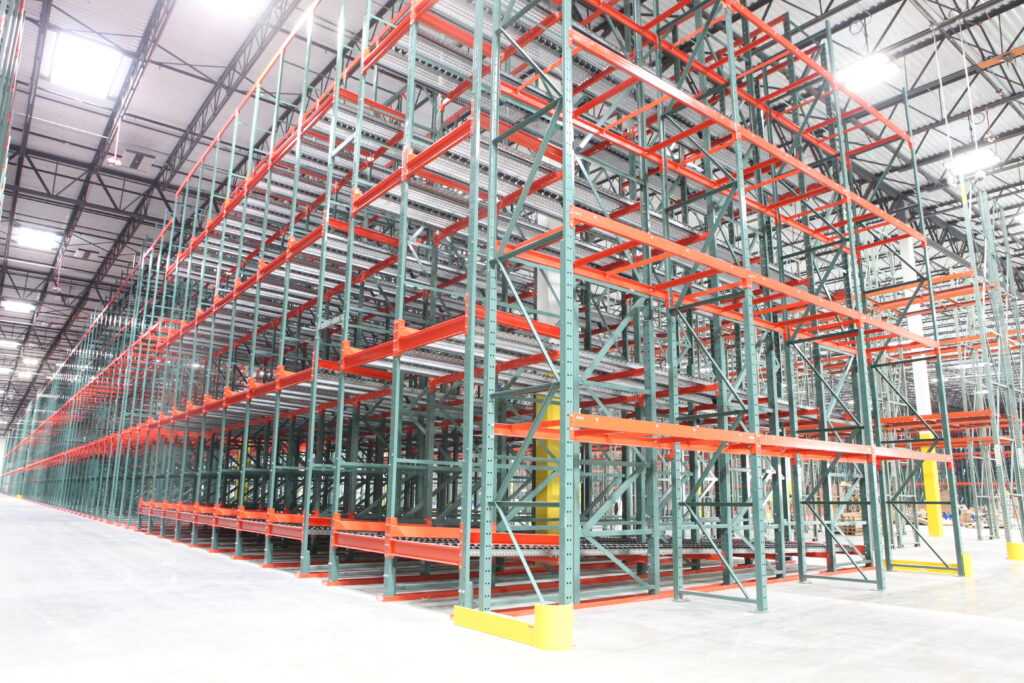
Customized Pallet Storage Improves Inventory Tracking & Control
- Inventory control – Depending on your SKU units and volume, a manual inventory control system may make sense. They can be very accurate but are slower than the real-time processing of an automated system. The goal is to establish a system that can provide a precise count of stocked inventory at all times. Upgrading to an automated system can save money in reducing shrinkage losses, labor costs, and insurance costs. Automated WCS also helps maximize your warehouse space to improve productivity.
- Pallet racking and right-sized storage applications – Storage racking tailored to your inventory mix delivers a quick ROI in protecting inventory from damage and misplacement, as well as improving worker productivity. Whether storing full pallets, cases, or individual items, racking creates an orderly storage solution and allows you to utilize otherwise wasted vertical space while creating a safer flow for your crew and equipment. Equipping pallet racks with decking, safety netting, and or pallet stops are effective options for protecting items from falling, possibly injuring workers, and, of course, becoming damaged.
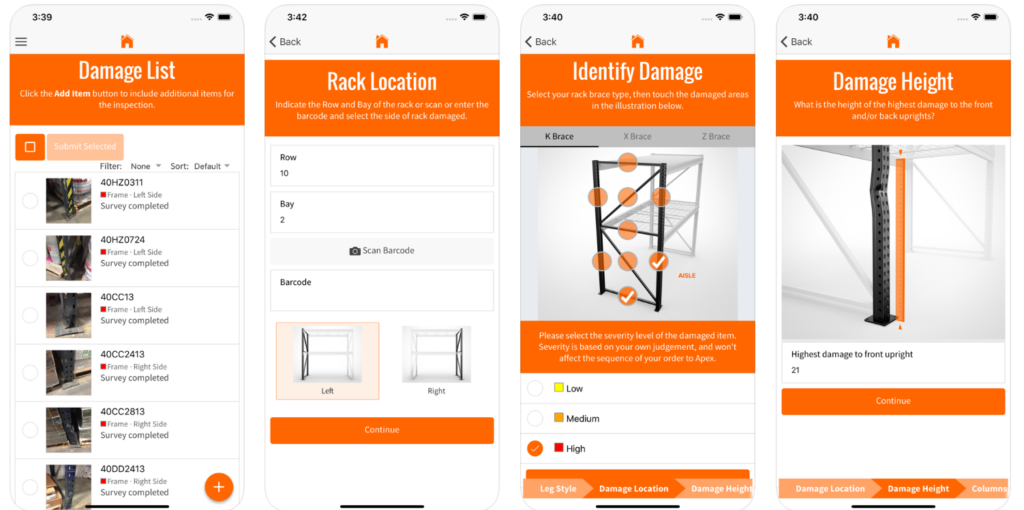
3. Regular inspections – Your first line of defense is your team. Train your team to look for compromised pallets that could break during handling and overloaded or damaged pallet racking. Regular rack and warehouse safety inspections will help you identify and rectify dangers before they become costly or tragic. The Apex Rack Repair app is a free app that you can use to guide your rack inspections. The simple touchscreen app lets you quickly record rack damage from preloaded specs and even add pictures. Your completed rack inspection is then uploaded to the Apex PROs to evaluate and provide a comprehensive report with any necessary repair advice.
The Apex Rack Repair app is also ideal for quickly responding to forklift vs. rack incidents. Send the Apex PROs your on-the-ground evaluation, and we will promptly let you know if the system is compromised and requires unloading.
4. Comprehensive forklift operator training and certification – Forklift operators must be trained on the equipment they use in your facility… that’s not Apex talking; that’s OSHA (but we agree). Remember also that certification must be renewed every 3 years for Class 1-5 vehicles and 5 years for Class 7 equipment. Confident operators are more productive and safer overall, resulting in less inventory damage, pallet racking mishaps, and material handling equipment repairs. Contact the Apex team to schedule OSHA-compliant, comprehensive, on-site group training.
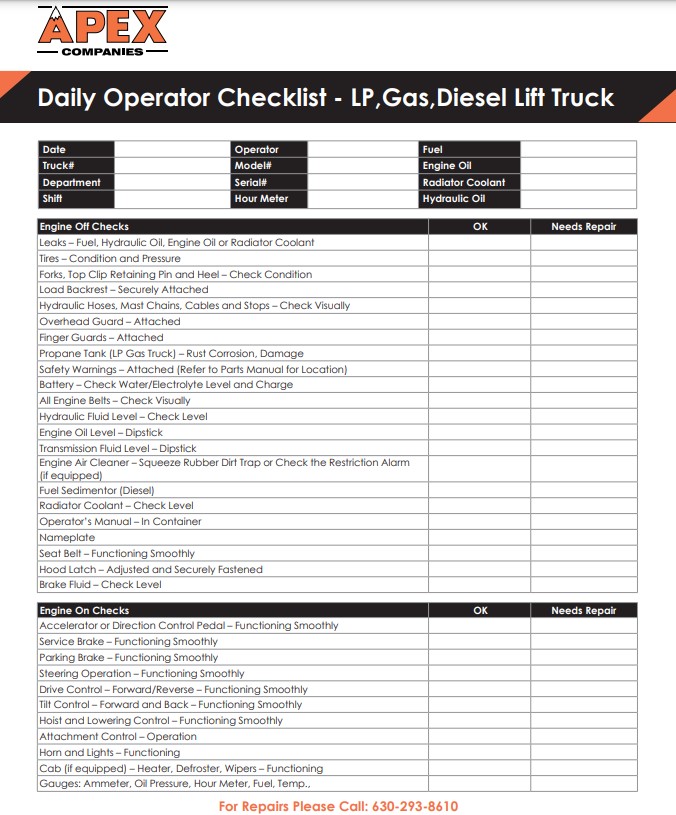
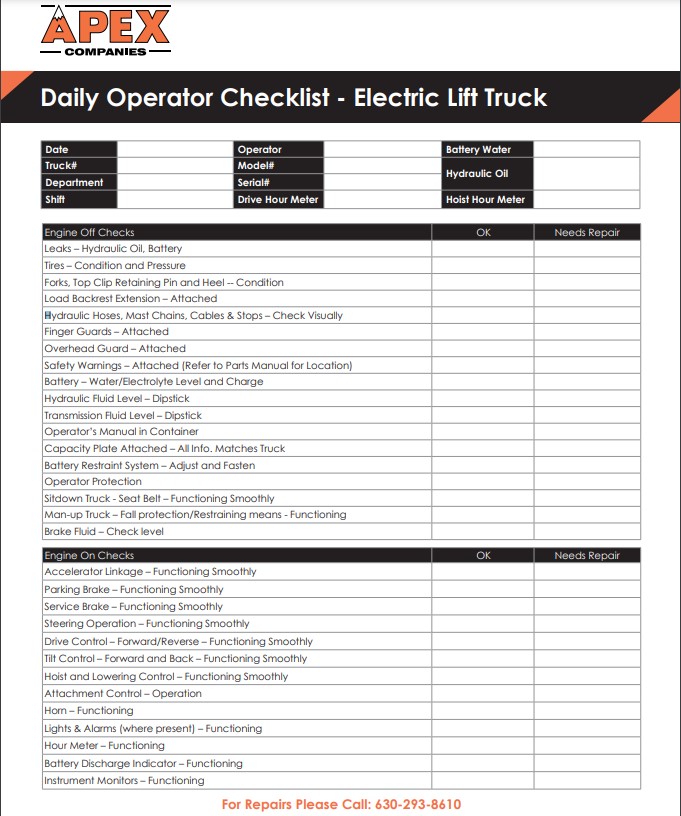
Also, encourage operators to conduct daily forklift inspections before beginning a shift to promote your overarching warehouse safety goals. Download our Forklift Inspection Forms to get started.
|
|
|
5. Regular material handling equipment maintenance – Dovetailing on operator safety, ensure your forklifts and warehouse vehicles are correctly paired with the pallet racking and required load capacity. Forklift size, turn radius, mast height, and load balance are critical in matching the best vehicle to your needs –protecting inventory, equipment, and personnel from damage. Also, consider smaller material handling equipment to lighten the load on workers and minimize larger forklift vehicle traffic. Electric pallet jacks, walkies, and stackers have broad applications, are easy to use, and are nimble for smaller workspaces.
Additionally, your vehicles should be regularly serviced. Fleet service plans are a good option to take that concern off your to-do list. Fleet service plans often extend the useful life of your forklifts by catching small things before they become significant and costly.
6. Keep it clean policy – Clutter, dirt, and debris, do one thing effectively… create a hazardous work environment. Establishing a clean warehouse policy improves working conditions for your team to protect your inventory from damage and protects workers from injury, which often has a positive rebound effect on job satisfaction and productivity rates. A clean facility will also leave a positive impression on customers and inspectors.
7. Workplace safety policy – Assuming you’ve implemented a clean warehouse policy, you can still do more to improve the working conditions and thus boost worker morale. Happier workers stay with the company longer, becoming more skilled and attentive to operational hazards. They are also less likely to make costly mistakes and steal items.
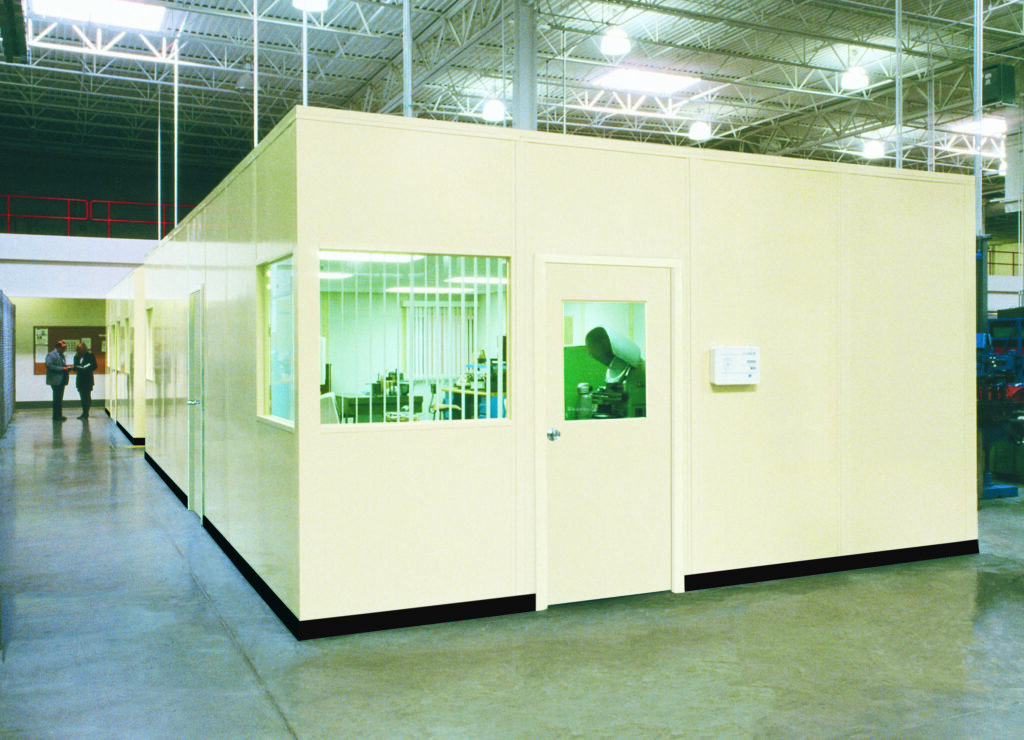
Combat fatigue by establishing route breaks and providing a safe, pleasant break area (check out our modular break rooms for a super quick, economical solution). Where possible, control the noise level to enable workers to hear vehicles, equipment, and alarms. Also, maintain proper lighting (replace broken bulbs, eliminate dark workspaces), post effective signage, and conduct regular safety training to remind your team that their safety is important to you and that they are a valuable part of that effort.
Go Big to Combat Shrinkage, Call Apex
If it takes all seven steps listed above to reach your warehouse safety and shrinkage goals, then Apex will be with you every step. Our full-service warehouse support ensures a seamless process whether you’re seeking an integrated warehouse automation solution, custom-configured pallet racking solutions, warehouse design and flow analysis, material handling equipment operation and service –all the way through inspections, repairs, and maintenance. The Apex team acts as an extension of your team to keep your operation flowing smoothly so you can concentrate on what you do best.
Contact Apex today –We Got This!
