
Special Considerations for Palletizing & Storing Bagged Inventory

Tidy, Stable Palletizing & Storage IS Achievable for Bagged Inventory – Follow These Tips
Automation is all the rage in warehousing, manufacturing, and distribution. Undoubtedly, the trend towards automation has steadily increased for years. Then 2020 hit and it became supercharged. Palletizing is one of those applications that caught the automation wave due to its ability to streamline and increase productivity. It also helps reduce worker injuries and associated downtime and costs. BUT, what if your inventory doesn’t fit in tidy, consistently-sized boxes and instead is contained in shifting slippery bags? What is the most effective process for palletizing and storing these loads that is safe and efficient? These are all reasonable questions, and we’ve got helpful tips to guide you to the answers.
7 Tips to a Smooth Palletizing Process for Bagged Inventory
Automating all or part of your palletizing activity can work for bagged inventory if you follow these tips.
- Even Distribution – contents of the pallet load must be evenly distributed on the pallet without empty or uneven spaces that can cause inventory shifting and point loading (a concentrated area of weight that destabilizes the pallet load).
- Load Heavy to Light – if your bagged content varies in weight, load the heaviest bags on the bottom, followed by lighter bags on top.
- Pallet Overhang – place the bags in a way that prevents overhang. Overhang is a safety concern as it can throw off the pallet load’s weight distribution, causing forklift and storage rack hazards. It can also block electronic eyes from properly scanning the pallet. This can trigger an emergency stop of the system, requiring attention and slowing down your process.
- Smooth Edges – any rails, guards, or stops in your palletizing apparatus must be free from sharp edges that could puncture or rip the bags.
- Pallet Wrapping – plastic wrapping the pallet load is a safety must, but the unstable content can make this a challenge. Pallet turntables rotate pallets to apply the wrap; however, a rotating wrapper that holds the pallet still while wrapping around the load is something to consider to prevent bags from shifting during movement.
- Seeing is Believing – while plastic wrap is important to load stability, you will still want to see through the wrap enough to determine if the load shifted at any point during the process or in transport.
- Pallet Quality – good quality pallets are recommended across the board for warehouse safety, whether palletizing, carrying by forklift, or even sitting on pallet rack. Also, adding a slip sheet between the pallet surface and the load can even the surface for palletizing.
Storage for Palletized Inventory
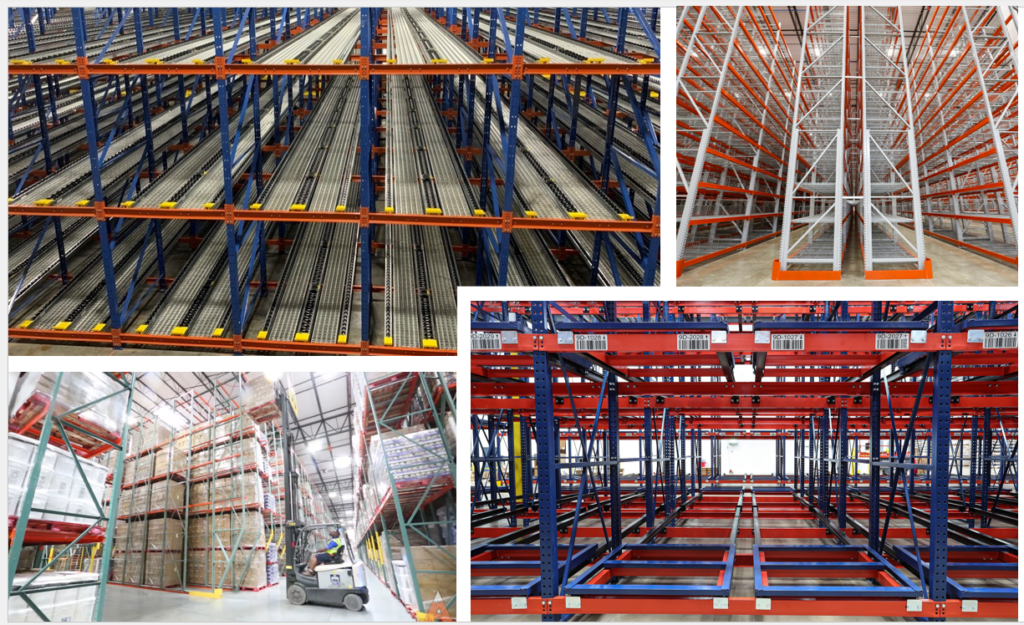
From Top Left – Pallet Flow, Back-to-Back Rack, Drive-In, Push-Back
Ok, so now you have neatly stacked and wrapped pallets –what should you do with them? Several pallet racking solutions fit right along with your goals of improving productivity and safety.
Pallet Storage Racking
- Selective Pallet Rack
- Drive-In Pallet Rack
- Push-Back Rack
- Pallet Flow Rack
- ASRS – Automated Storage and Retrieval Systems
Selective pallet rack is the most simple of the systems. It stores one pallet deep and is a cost-effective way to maximize your vertical space. Standard forklifts access the system from a single aisleway. Most often, selective rack is placed back-to-back to reduce the number of aisles needed for system access. You can design your system for two-deep storage (called double-deep); however, you will need a deep-reach forklift.
Drive-in pallet rack is a high-density storage system that requires only a single aisle for access but creates SKU lanes up to 10 pallets deep and multiple levels high. This rack requires skilled forklift operators as they have to drive into the lanes to place and extract pallets. Drive-in is a Last-In/First-Out (LIFO) rack system.
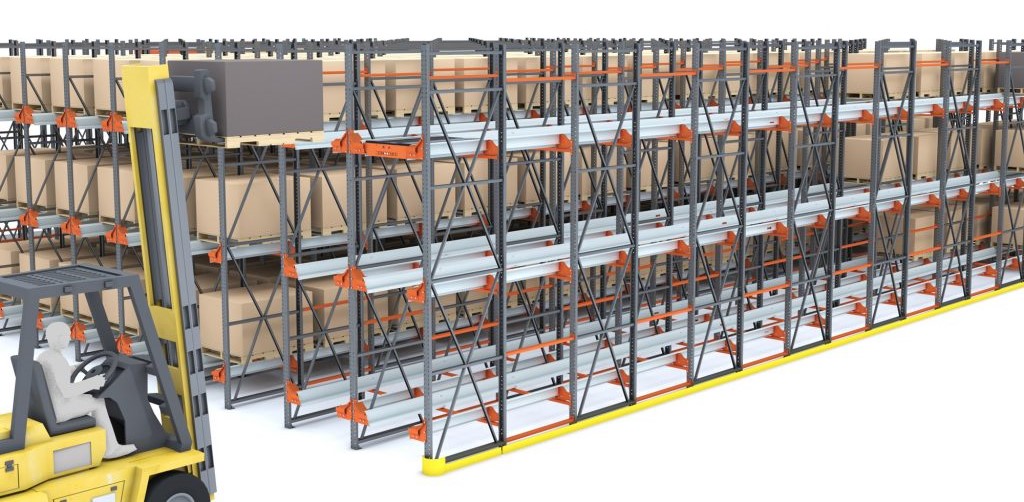
Push-back rack is also a LIFO storage option, but it adds a dynamic feature to the system design. Pallets are placed in SKU lanes on wheeled carts –typically 3-4 pallets deep. The forklift pushes back the pallet in the first position to load additional pallets in the lane. The rear pallets automatically flow forward when pallets are removed to keep the first position filled. The carts are stacked so that the rear pallet sits up a little higher than the front pallet, limiting the number of levels vs. other storage racks, but the high-density and dynamic features can improve efficiency.
Pallet flow rack is also a dynamic pallet storage option; however, it is a First-In/First-Out (FIFO) inventory rotation solution. Pallet flow relies on pitched rails of wheels or rollers to propel the pallets from the load side of the system down to the opposite (extraction) side. It is a high-density system for between 2-10 pallets deep per lane.
ASRS is a semi- to fully-automated, high-density pallet storage system. Pallets enter the system via forklift putwall or conveyor and then are picked up and carried by shuttle to open storage bays. The process reverses to extract them. These systems are best suited for high-volume, fast-moving inventory. Due to the high level of automation, ASRS systems are extremely useful in frozen and cold-storage facilities to minimize worker exposure.
Building a Better Solution
Palletizing may be your answer but let‘s ensure that the right questions are asked. The Apex team is a full-service warehouse services provider that works with you to ensure that your design, systems, and equipment optimize your space and labor potential. Considering your current challenges, future expectations, and facility layout, we will match the most effective storage and processing tools to meet your goals.
Call Apex for a free consultation and to schedule an on-site visit. Check out our photo, illustration, and video galleries for inspiration and ideas.
