
Warehouse Mezzanines in Utah
Custom Design & Professional Installation
Utah warehouses face a familiar challenge: floor space is at a premium, real estate costs keep climbing, and relocating to a larger facility isn't always practical. From Salt Lake City to mountain west distribution facilities managing rising inventory volumes, the demand for additional usable square footage within an existing footprint is constant.
Apex designs and installs custom warehouse mezzanine systems for Utah warehouses, converting unused vertical space into functional square footage, whether for storage, office areas, pick operations, or equipment platforms. Every system is engineered to your operation and built to code, with professional installation managed from start to finish.
Schedule a warehouse walk-through with Apex's Salt Lake City team to evaluate your facility's fit.
Schedule a Walk-ThroughMezzanine Systems: Rack Supported vs. Freestanding Platforms
Choosing the right mezzanine starts with how the platform will be used and what's already on the main floor below. The two primary systems are rack-supported platforms and freestanding industrial work platforms (IWPs), and the structural differences shape cost, flexibility, and what you can put underneath. We design mezzanines around how your operation actually runs, not just what fills the square footage.
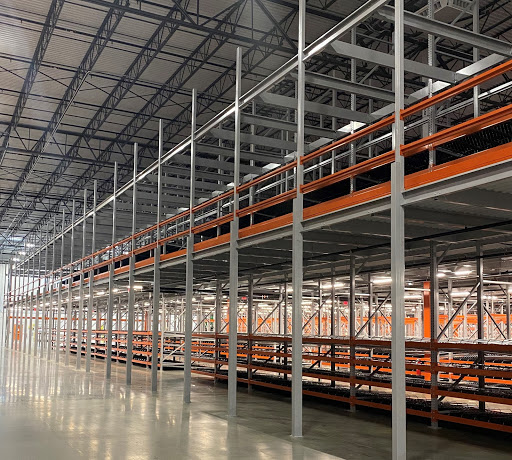
Rack Supported Mezzanine Systems
Rack-supported mezzanines are configured within your existing pallet storage racking, using that structure as the foundation for the upper level. This approach eliminates separate columns and footings, reduces installation costs, and keeps more floor space open below.
Key advantages:
Rack-supported systems work best when the priority is combining active storage on the lower level with elevated walkways and operational space above. The lower bays continue to function for pallet picking and putaway throughout installation, which matters in operations that can't easily pause inventory movement.
Freestanding Industrial Work Platforms
Freestanding industrial work platforms stand independently of any storage system, supported by their own structural columns anchored to the floor slab. This gives you more flexibility in column placement and the ability to modify, expand, or relocate the platform as the operation changes.
Key advantages:
Freestanding platforms are the right choice when operations demand flexibility, when upper-level loads exceed what rack-supported mezzanine construction can carry, or when the space below needs to stay open for forklift travel, equipment, or production work.
Economical Shelving-Supported Mezzanines
A third design option suits smaller, storage-focused structures. When the goal is additional storage rather than office or heavy equipment use, a shelving-supported mezzanine uses industrial steel shelving as the base of the mezzanine structure itself. This eliminates separate structural columns and traditional construction, making it one of the most cost effective approaches to adding vertical storage capacity inside an existing facility. Cost effectiveness here comes from leveraging shelving you may already have or plan to install.
Advantages:
Configurations include open or closed shelving, solid or permeable decking surfaces, and lift access between levels. The system pairs well with material handling equipment built for shelving rather than full pallet operations, making it a practical fit for fulfillment areas, slow-mover storage, and parts rooms.
Shelving-supported mezzanines are not a fit for heavy pallet loads, forklift access to the upper level, or operations that need to move bulk product between levels. When load requirements or material flow exceed what shelving can support, a rack-supported or freestanding system is the appropriate direction.
Common Mezzanine Applications in Utah Warehouses
Utah warehouses and distribution centers span various industries, from food and beverage to e-commerce fulfillment, manufacturing, and outdoor recreation logistics. The core benefit stays consistent: more usable space without the cost of new construction or relocating your business. In many facilities, adding a mezzanine can be more cost-effective per square foot than a building addition or new lease, depending on ceiling height, slab capacity, and operational requirements. For Utah facilities with sufficient ceiling clearance and stable workflows, building up improves efficiency and usually doubles usable capacity without expanding the footprint.
Office Space and Personnel Areas
When the warehouse floor is fully allocated to product, mezzanine-level offices solve one of the most common layout problems: where to put personnel. In-plant modular offices, work areas, break rooms, and controlled environments keep people off the production floor without consuming warehouse floor space.
For many warehouse environments, modular mezzanine office structures can be installed with less disruption than traditional construction, while supporting HVAC, electrical, and access requirements. For Utah facilities with limited administrative space adjacent to the warehouse, a mezzanine office platform is often a practical way to add personnel space without giving up production floor.
Equipment Storage and Mechanical Rooms
Mezzanine platforms free up ground-level floor space by relocating equipment, mechanical systems, and storage to the upper level. Security enclosures and controlled environments can be built into the design for equipment requiring limited access or climate control.
Customizing the structure around specific equipment dimensions, load requirements, and access points means these rooms serve exactly the functions needed. For Utah distribution and manufacturing facilities where ground-level space is allocated to production or fulfillment, moving mechanical functions overhead recovers real operational capacity.
Pick Module Storage Systems
Pick modules on mezzanine structures range from elevated storage with dedicated pick zones to complex multi-level systems integrated with conveyors, flow rack, and sortation equipment. Safety is a top priority in every pick module: compliant mezzanine stairs, fall protection, handrails, and toe boards are standard. For high-volume distribution centers serving Utah's growing e-commerce and 3PL sectors, pick modules increase pick throughput and productivity without adding warehouse square footage.
Pick modules are typically premature when order volume or SKU velocity data isn't stable enough to drive slotting, when the operation hasn't settled on a picking methodology, or when projected throughput doesn't yet justify the capital and engineering involved in a multi-level structure. A simpler shelving or flow-rack layout often serves better until volume and process are proven.
Mezzanine Selection: What to Consider for Your Utah Facility
A mezzanine isn't right for every facility. The constraints below shape whether a system fits, what it costs, and how long it takes. Evaluating these before committing to a design direction prevents costly mistakes and sets the project up for a successful installation.
Ceiling Clearance & Slab Capacity
Ceiling clearance has to accommodate the deck, structural depth, and functional working height above the platform, and the floor slab must support the column point loads the structure transfers down. A site assessment confirms whether the slab meets load requirements or whether remediation is needed before engineering begins.
Utah Seismic & Permitting
Utah's seismic activity along the Wasatch Front shapes structural design, with permitting handled directly through the local jurisdiction. Mezzanines installed in Salt Lake City, Provo, Ogden, and surrounding areas must meet state and local seismic engineering standards.
Operational Fit
Mezzanines perform best when workflows are stable and the upper-level use is clearly defined. Operations that need to operate with frequent layout changes or low-clearance crane coverage may find a mezzanine more restrictive than useful.
Material Movement & Access
Material movement between levels is handled by vertical reciprocating conveyors, pallet gates, and IBC-compliant mezzanine stairs for personnel, all settled in design rather than after fabrication. Electrical and HVAC requirements for the upper level need to be resolved during design, before fabrication begins.
Talk to an Apex engineer about whether a mezzanine fits your facility before committing to a design direction.
(833) 903-5246Mezzanine Components and Construction Details
A mezzanine's foundation is its column and beam framing: structural steel sized to load and span requirements, with columns transferring load to the slab and beams and joists supporting the decking. The materials selected for decking, access, safety, and finish follow intended use, load requirements, and the facility environment.
Structural Framing
Structural steel sized to load and span requirements, with columns transferring load to the slab and beams and joists supporting the decking.
Decking Materials
Bar grating allows drainage and light transmission, resin board suits foot traffic and small-item storage, and concrete over metal deck handles heavy-duty applications. Wood plank decking is also available for specific applications.
Access Solutions
IBC-compliant mezzanine stairs and vertical reciprocating conveyors for product transfer. Pallet gates allow forklifts to load pallets onto the upper level while preventing pedestrians from accessing the open position.
Safety Standards
Handrails, toe boards, kick plates, and gates follow OSHA fall-protection requirements at all open edges and access points. Integrated from the start, not added afterward.
Finish Options
Powder coating protects steel from corrosion, with galvanizing available for cold storage, food distribution, and other Utah environments involving moisture or temperature variation.
Safety Standards
Talk to a storage expert
When a Mezzanine Is (and Isn't) the Right Solution
Apex's approach is consultative. If a mezzanine isn't the best solution for your facility, we'll say so.
Best Fit When:
Not the Best Fit When:
When a mezzanine isn't the answer, other solutions exist. High-density vertical storage like vertical lift modules and carousels can add capacity at ground level within the existing footprint. Reorganizing the current layout sometimes recovers more space than expected. Apex helps evaluate which option fits your operation, your facility, and your operational needs.
Mezzanine Design and Installation in Utah: Apex's Regional Expertise
Apex's Salt Lake City location serves Utah warehouses and distribution facilities across the mountain west, with direct working knowledge of building codes, seismic requirements, and the permit processes specific to Salt Lake City, Provo, Ogden, and surrounding jurisdictions. Our company brings 20+ years of warehouse expertise to every project, with local presence that helps streamline coordination during permitting, engineering, and installation.
Utah's industry spans food and beverage, outdoor recreation, tech manufacturing, and e-commerce fulfillment, with each sector bringing different facility constraints and unique needs. Installing mezzanines across these environments requires understanding how each business operates and what the space needs to accomplish long-term. From engineering through permitting, fabrication, and professional installation, the team manages the full project and provides ongoing support so your operation stays focused on running the warehouse. Our services cover every phase from design through final inspection.
Site Survey & 3D Design
AutoCAD modeling for every project
PE-Certified Engineering
Stamped drawings available
Local Project Management
Utah regional team on-site
Request a Project Review for Your Utah Facility
Request a project review with Apex's Salt Lake City team. We'll assess your ceiling height, floor load capacity, and operational requirements to determine whether a mezzanine is the right fit, and which system type and design approach makes the most sense for your Utah facility.
Call (833) 903-5246 to start the conversation.