
Cantilever Racking in Utah
Salt Lake City Storage Solutions
When inventory is too long, too bulky, or too irregular to sit on a standard pallet, it usually ends up on the floor. Utah warehouses deal with this constantly with dimensional lumber, steel bar stock, pipe, poles, rolled textiles, and oversized furniture components across construction, distribution, and manufacturing operations in the Mountain West.
Cantilever racks solve that problem with upright columns and arms that extend outward, leaving the rack face open for long items of varying lengths. Apex's Salt Lake City team designs and installs cantilever racking systems for Utah operations, backed by regional service coverage and nationwide installation experience.
Not sure cantilever is the right system? Talk to a storage expert for a layout review before specifying arm type, capacity, or column spacing.
Request a Layout Review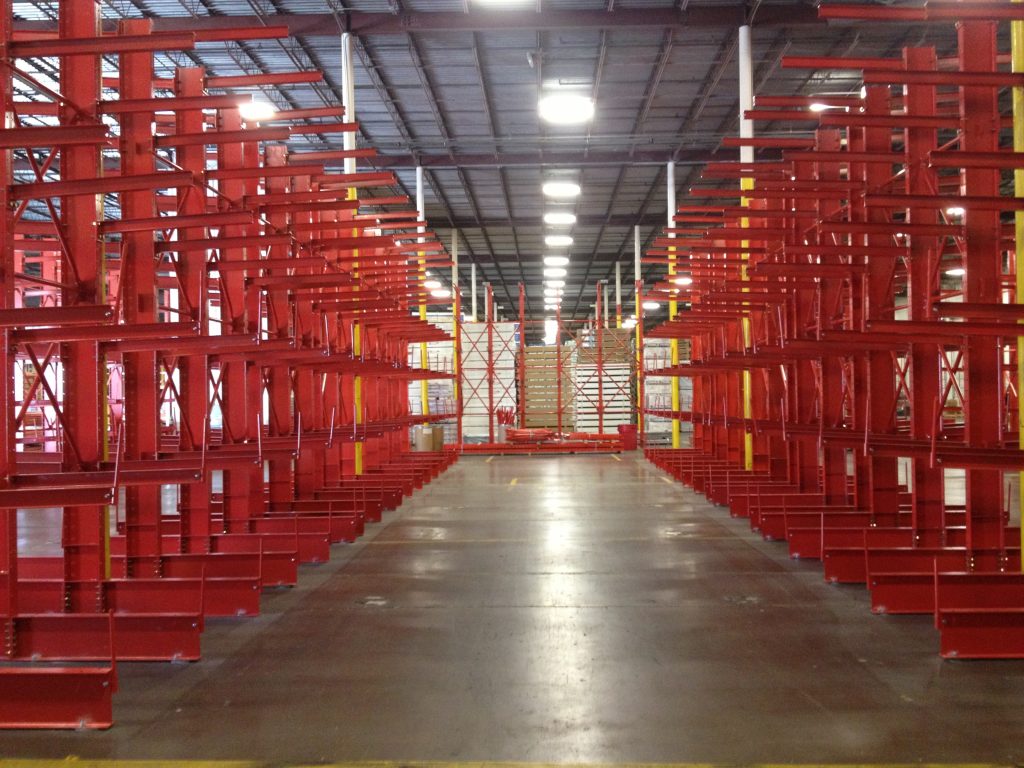
What Cantilever Racking Is and How It Works
Cantilever systems use vertical columns fitted with arms that extend outward from the uprights, creating open vertical storage for long materials and irregularly shaped items. Unlike standard pallet racks, which use horizontal beams to carry uniform palletized loads, cantilever leaves the rack face unobstructed so items of varying lengths can store from the same column.
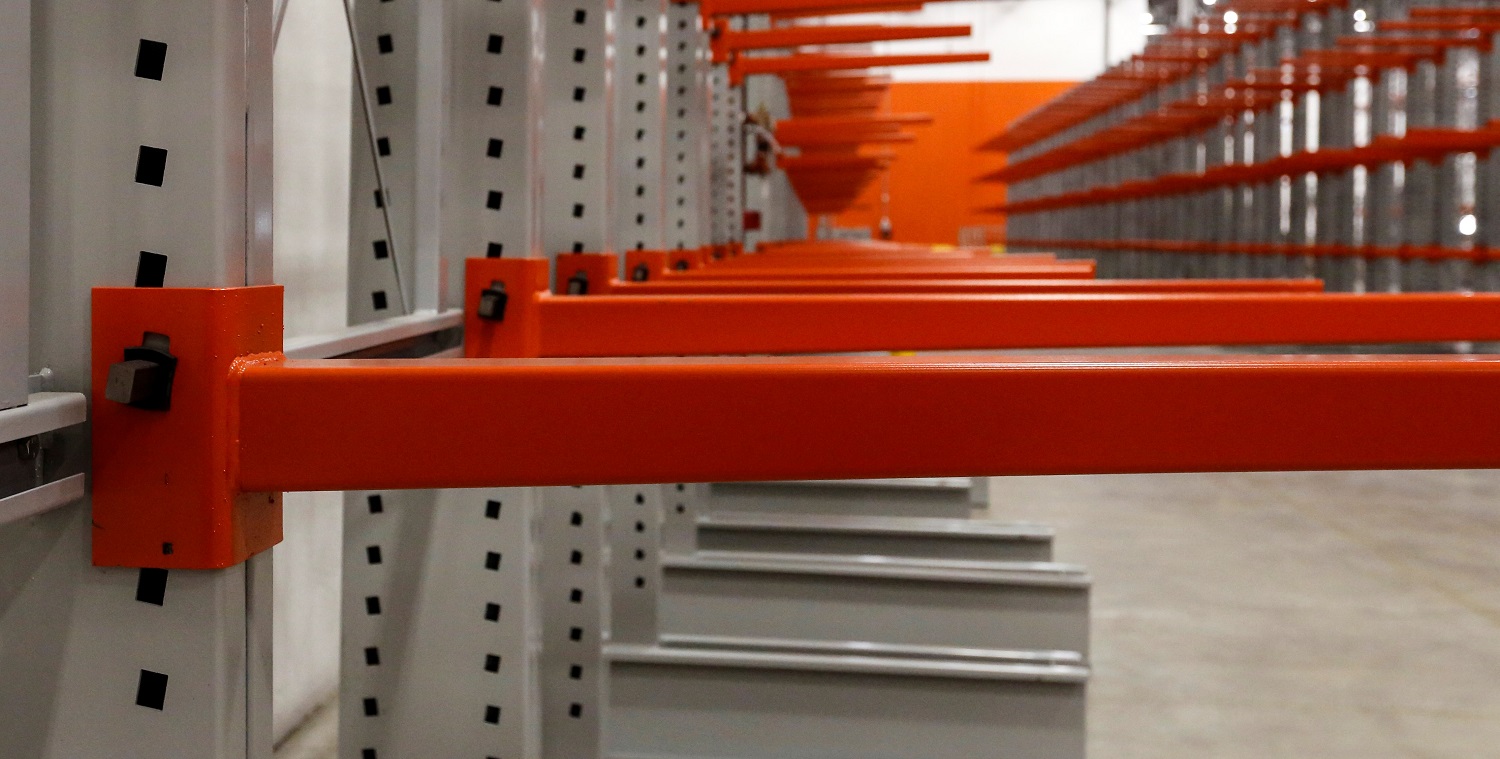
Arms bolt or clamp to the upright for straightforward installation and repositioning. Bases anchor each column to the floor, and horizontal bracing connects uprights within a row to keep the system rigid under load. Single-sided units carry arms on one face; double-sided units carry arms on both faces for higher capacity per row where aisle access allows.
Cantilever Racking Features
No Front Columns
Open-face design provides unobstructed access for loading and unloading long materials. No vertical posts blocking inventory.
Adjustable Arms
Bolt or clamp arms to uprights at customizable heights. Reposition arms as inventory profiles change without structural modifications.
Single or Double-Sided
Choose single-sided for perimeter walls or double-sided to maximize storage capacity per row with aisle access from both sides.
Multiple Arm Types
Straight arms for flat materials, inclined arms for pipe and bar stock, axel arms for rolled goods—mix types within one system.
Roll-Formed or Structural
Roll-formed steel for light to medium-duty indoor applications. Structural steel for heavy-duty loads and outdoor installations.
Custom Configurations
Spec arm length, capacity, height, and punch increments to match your exact inventory dimensions and facility constraints.
Why Utah Businesses Choose Cantilever Racking
A lot of Utah inventory simply doesn't palletize. Steel, dimensional lumber, PVC and other pipe, furniture components, and rolled materials all overhang or fall through standard pallet rack beams, making cantilever the default storage solution for most industries across the Wasatch Front, in Ogden, Provo, and rural lumber and steel operations.
Apex's local Salt Lake City sales team works directly with operations on layout design and installation, matching available space, existing material handling equipment, and inventory requirements. Common applications include lumber yards, steel distributors, furniture warehouses, pipe and PVC suppliers, home improvement retail, and construction material suppliers.
Talk to a storage expert about your project
Common Utah Applications
Single-Sided vs. Double-Sided Cantilever Systems
Configuration affects storage capacity, aisle width, and traffic flow, so the right choice depends on available space and forklift type. Apex's Utah team can review your layout as part of the warehouse design process and help confirm which configuration fits before you commit.
Single-Sided
Arms on one face of the upright column. Works well when racking runs along walls or the perimeter of a facility, keeping the footprint compact and installation straightforward.
Double-Sided
Arms on both faces, maximizing storage capacity per row when aisle access is available from both sides. Requires equipment clearance on both sides.
Cantilever Rack Arm Types and Weight Capacity
Standard cantilever arms support between 250 and 2,000 lbs per arm, with heavy-duty options for higher weight capacity requirements. The right arm depends on inventory weight, shape, and arm length. Spec capacity against the heaviest single load per arm, not an average.
| Arm Type | Capacity | Best For |
|---|---|---|
| Straight arms | 250–2,000 lbs | Nearly flat with a 2 to 4 degree incline. Designed for flat or sheet materials including wood, plywood, sheet metal, and general construction materials. Most lumber and steel stock storage uses straight arms. |
| Inclined arms | 250–2,000 lbs | Slope upward from the column connection. The incline keeps round inventory from rolling off, making them the right choice for pipe, bar stock, poles, PVC, and other cylindrical items. |
| Axel arms | Varies by design | Use rollers at each endpoint to support the axle of rolled materials such as carpeting, fabric, and wrapping, holding the roll securely and accessibly for picking. |
Three arm types cover most applications, and different styles can be mixed within the same system: lumber on straight arms at one level, pipe on inclined arms at the next, rolled textiles on axel arms above. Pipe stops mount at arm ends to prevent materials from sliding off during loading and retrieval.
Roll-Formed vs. Structural Steel Cantilever Rack
Material choice affects cost, capacity, installation, and long-term fit. Two primary types cover most applications.
Roll-Formed Steel
Lighter, lower in cost, and easier to reconfigure, making it appropriate for light to medium-duty applications. Most indoor warehouse and distribution operations fit here.
Structural Steel
Built from hot-rolled shapes, heavier, more rigid, and capable of significantly higher load capacities including dense materials across longer arm spans. The right choice for heavy industrial environments, outdoor installations, and operations storing steel plate or heavy pipe.
Important: In most cases, roll-formed and structural components are not interchangeable within the same system. When expanding an existing installation, match the original material type.
Where Cantilever Racking Fits Best
Cantilever is the right system when inventory is long, bulky, or irregular and doesn't palletize cleanly. Industries that rely on it include:
- Lumber yards and building material suppliers
- Steel distributors handling bar stock, flat stock, and tubing
- Pipe, PVC, and plumbing supply operations
- Furniture warehouses and home improvement retail
- Carpet, textile, and rolled material distributors
- Construction material and supply facilities
- Manufacturing operations storing raw stock and components
Forklift access to any level supports productivity, clear sightlines improve visibility and inventory accuracy, and getting bulky materials off the floor improves safety and protects stock compared to floor stacking. Utah operations that store long items benefit from cantilever's ability to use vertical space that standard shelving can't reach.
Not a Fit When...
Cantilever is purpose-built, which means it's not the right answer for every inventory profile. A different system usually makes more sense in these situations:
Standard palletized loads: If product arrives and ships on standard pallets, selective rack, drive-in, or pallet flow will generally deliver better density and simpler operation.
High-turnover small parts: Carton flow or industrial shelving is typically better suited for case picking and small-part picking.
Very short items: Compact inventory that fits cleanly on standard shelving rarely justifies the cost and complexity of cantilever.
Extremely heavy, concentrated loads: Some applications exceed standard cantilever capacity ranges. For unusually dense materials, confirm the system is spec'd for those loads before ordering.
Inventory profile not yet documented: If load weights, maximum lengths, and SKU volume haven't been captured, a cantilever spec is premature. Arm length, capacity rating, column spacing, and aisle width all depend on that data, so operations in a pilot or ramp-up phase benefit from gathering a stable inventory profile before committing to a layout.
If cantilever isn't the right fit, the Apex team will say so and recommend the system that is.
Design Considerations Before You Order
The key inputs to confirm before contacting Apex:
Material type
Roll-formed vs. structural steel based on load requirements and budget. This decision drives most of what follows.
Rack height
Ceiling clearance plus overhead obstructions and safe forklift clearance above the top arm level.
Arm style & capacity
Match arm type to inventory profile and spec capacity against the heaviest load per arm.
Punch increments
Uprights are typically punched at 3" or 6" intervals. Confirm the increment matches how precisely you need to position arms.
Number of arms
Enough arms per upright to support load without deflection and extend system life.
Arm length
Arms must be at least as deep as the inventory they support, with no overhang.
Building & floor constraints
Slab condition, thickness, and rated PSI before installation. Confirm aisle widths against your forklift equipment before finalizing layout.
Cantilever Racking vs. Standard Pallet Racks
Standard pallet racks are built for uniform, palletized loads. That's how pallet racking works best: consistent pallets, predictable retrieval patterns, and stable load dimensions. If product arrives on standard pallets and stays on them through storage and retrieval, a pallet racking system will support better warehouse efficiency for that inventory type.
Cantilever is for inventory that doesn't palletize: long materials, irregular shapes, items that overhang pallet edges, and SKUs that vary significantly in length. Apex provides both system types, along with new and used options on standard pallet rack components through the online shop. The team can help determine which solution fits, or whether a combination of racking systems makes sense for your facility.
Cantilever Racking Accessories and Safety Features
A complete cantilever system includes more than uprights and arms. Common accessories that improve stability, protect inventory, and support safe operation:
Safety Checklist
New Cantilever Racking Options in Utah
New cantilever racking is custom-configured to your specifications, including arm type, capacity, height, configuration, and material type. Systems can be purchased with manufacturer warranties and are built to current load and safety standards.
Apex specs cantilever systems to match your inventory, your available space, and your operational requirements. Products are sourced through established manufacturer relationships and delivered with installation by the Apex Utah team.
Why Utah Businesses Choose Apex
If your inventory is long, bulky, or irregular in shape, cantilever racking is built for it. Apex's Utah team is ready to help you design the right system, plan your layout, and manage installation from start to finish.
With 20+ years of experience across storage, automation, and material handling, Apex brings practical expertise to every project. The Salt Lake City team works directly with Utah businesses to spec systems that match your space, your inventory, and your operation.
Get Expert Help Selecting Cantilever Racking in Utah
If your inventory is long, bulky, or irregular, cantilever racking is built for it. Apex's Utah team can help you design the right system, plan your layout, and manage installation from start to finish.
Schedule a warehouse walk-through with the Utah team, or call (833) 903-5246 for a layout review.