Push-Back Racking in North Carolina | High-Density LIFO Storage Solutions
Push-back racking gives North Carolina warehouses a practical way to increase pallet storage density without adding more floor space. Instead of using every pallet position as a single-deep selective rack location, push-back systems store pallets multiple positions deep while keeping each lane accessible from the aisle.
This makes push-back a strong fit for operations that store multiple pallets of the same SKU, need better space utilization, and want more selectivity than drive-in rack can provide. It is especially useful for distribution, manufacturing, food and beverage, and regional warehouse operations where inventory moves in repeatable batches and storage space needs to work harder.
Talk to an Apex engineer about your warehouse project.
Push-Back Racking: High-Density Storage Meets SKU Selectivity
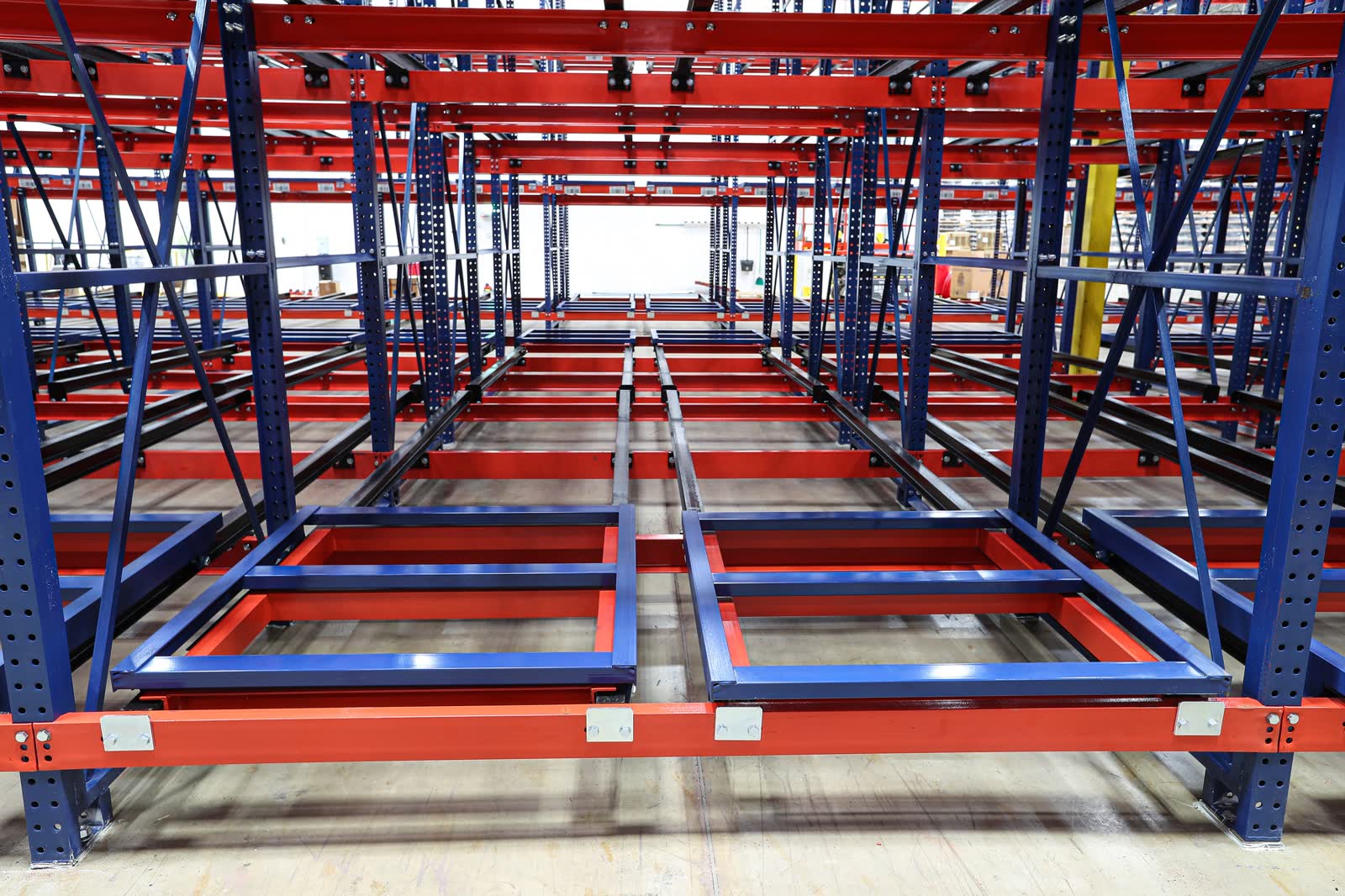
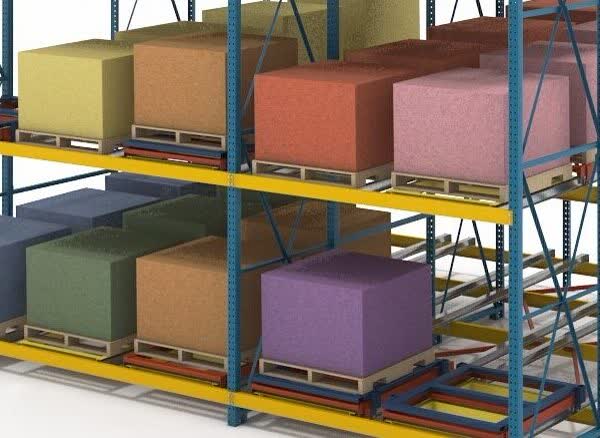
Push-back racking is a dynamic racking system featuring deep pallet lanes equipped with nested carts that ride inclined rails. Loading the first pallet pushes the cart behind it deeper into the lane. Pulling the front pallet lets gravity bring the next pallet forward. The result: high-density pallet racking systems that load and unload from a single aisle, with every lane dedicated to one SKU.
Configurations typically run 5 to 7 pallets deep, with 7 pallets deep as the maximum, depending on inventory profile and available space. Push-back rack improves storage density while keeping each lane accessible from the aisle. Each lane is typically assigned to a SKU, lot, or rotation group, giving warehouses better SKU access than drive-in rack in a more compact footprint than selective rack.
Push-Back Racking Advantages
100% SKU selectivity by lane
Each lane stores one SKU, no mixing or guesswork.
Higher pallet density with a smaller footprint
Push-back systems store more pallets without adding aisles, helping you maximize available space.
Ideal for high-volume, lower-SKU operations
Push-back performs best in high-volume, lower-SKU environments.
Reduced rack damage
Forklifts don't enter the rack system, minimizing damage risk.
Compact design
Increases pallet positions within the available warehouse footprint, helping lower cost per pallet position.
Cost effective compared to powered systems
Fewer moving parts than powered ASRS means lower upfront cost and less ongoing upkeep.
North Carolina Warehouse Storage: Apex Push-Back Racking Solutions
North Carolina facilities, especially along the I-85 and I-40 corridors through the Piedmont, face tight floor plates, code-compliant engineering, and aggressive timelines. Apex supports warehouses across the greater Charlotte area, Raleigh, Greensboro, Durham, Winston-Salem, Asheville, and the port city of Wilmington with design, engineering, and installation from a local Charlotte team backed by an in-state hub in Hickory, NC.
Rack systems installed in North Carolina need to meet the building code and wind-load requirements that apply to your site, and Apex engineers factor building conditions, floor slab specifications, and local code into the layout from the start. As a Licensed General Contractor in the Southeast, Apex coordinates permitting and installation under one accountable team. Quick Ship components reach North Carolina facilities efficiently from the in-state hub in Hickory, NC, with additional inventory available from Aurora, IL and Denver, CO.
Request a Project ReviewLocal Charlotte Team
- ›Design, engineering, installation
- ›Licensed General Contractor in the Southeast
- ›Building, slab, and code review
- ›Single point of contact through install
Your Apex contact in Charlotte coordinates the full project scope, from design through installation, backed by an in-state hub in Hickory, NC.
Push-Back Racking vs. Other High-Density Storage Systems
Choosing the right storage solution starts with understanding the trade-offs between density, selectivity, and equipment cost. Here is how push-back racking compares to common alternatives:
| System | Density | Selectivity | Productivity | Est. Cost/Position | Equipment Needed | LIFO/FIFO |
|---|---|---|---|---|---|---|
| Selective Pallet Racking | 3/10 | 10/10 | 7/10 | ~$150 | Standard forklift | N/A |
| Double-Deep Pallet Racking | 4/10 | 7/10 | 5/10 | ~$150 | Deep-reach forklift | LIFO |
| Drive-In Pallet Racking | 6/10 | 2/10 | 2/10 | ~$200 | Counterbalance forklift | LIFO |
| Push-Back Racking | 5/10 | 5/10 | 7/10 | ~$275 | Standard forklift | LIFO |
| Pallet Flow Rack | 7/10 | 5/10 | 8/10 | ~$375 | Standard forklift | FIFO |
Push-back racking fits between Selective Pallet Racking and Drive-In Pallet Racking. It provides higher storage density than selective, while offering better pallet access than drive-in, because operators load and retrieve pallets from the aisle rather than driving into the rack structure. Compared with Double-Deep Pallet Racking, push-back can provide deeper storage without requiring specialty forklift equipment. When it comes to pallet flow comparisons, it is mostly about FIFO vs. LIFO inventory rotation. Push-back is a strong choice when you need to balance density and pallet access for moderate volume SKUs. For full pallet access, choose selective rack. For greater density with less selectivity, consider drive-in rack. For FIFO rotation, Pallet Flow Rack is usually the better direction.
Where Push-Back Racking Works Best (And Where It Doesn't)
Ideal Applications
Push-back racking performs well in operations running high-volume inventory with a low number of SKUs. Distribution centers moving high-velocity product through a consistent pallet configuration get strong returns, and cold storage facilities benefit from consolidating inventory into fewer aisles and less conditioned space to maximize operational efficiency.
Push-back also works in facilities where available space is scarce and selective racking would demand too many aisles to hit the required pallet count. If your operation checks those boxes, the system pays for itself through density and throughput gains on a single aisle.
Not a Fit When
Push-back racking is not the right choice when FIFO rotation is required. LIFO is built into the system, so the first pallet loaded comes out last. If your products or processes can't accommodate that, pallet flow rack is the better direction.
Operations with minimal volume only one or two pallets per SKU won't see meaningful density gains from push-back. Variable pallet sizes are another mismatch, since the system is configured for uniform pallet specifications and inconsistent dimensions compromise alignment and safe operation. For inventory requiring access to every pallet at once, Selective Rack Systems are usually the more practical solution.
Where Push-Back Racking Works Best
Push-back racking is best suited for operations that store multiple pallets of the same SKU, lot, or product group and want better density than selective rack without moving to a drive-in system. It works well when inventory moves in batches, pallet flow is predictable, and operators need access to multiple lanes from a single aisle.
Before choosing push-back, Apex looks at pallet count per SKU, load weight, pallet quality, lift truck access, ceiling height, aisle layout, and inventory rotation requirements. Push-back is typically a better fit for LIFO storage than strict FIFO rotation, so it may not be the right choice for every date-sensitive or first-expired, first-out application.
Push-back racking performs well in operations running high-volume inventory with multiple SKUs concentrated in a relatively narrow product mix. Distribution centers moving high-velocity product through a consistent pallet configuration get strong returns on a high-density storage solution, and cold storage facilities benefit from consolidating inventory into fewer aisles and less conditioned space, where every cubic foot of climate-controlled space carries cost.
Push-back also works in facilities where available space is scarce and selective racking would demand too many aisles to hit the required pallet count. If your storage needs check those boxes, the system pays for itself through dense storage and throughput gains on a single aisle.
Building Requirements
Clear ceiling height is the starting point for any push-back design. You need enough height above the top pallet to accommodate the rack frame, the cart mechanism, and safe forklift clearance. Multiple levels of pallet storage are common in push-back layouts, which makes ceiling clearance even more important. Floor slab condition matters as well, since rack anchoring depends on a slab that can handle the point loads from the uprights. Aisle width depends on the forklift type you run, and an Apex engineer will walk your specific constraints before the layout is finalized.
Operational Requirements
Standard counterbalance and deep reach truck equipment work with push-back rack systems, so no specialty deep-reach equipment is required. Pallets need to meet a consistent size and weight spec throughout the system. Pallet weights must stay within rated cart capacity, and condition matters: warped, broken, or undersized pallets cause loading issues and create safety risks. Push-back loading technique differs from selective rack, so operator training is a real factor in maintaining warehouse efficiency, and Apex can provide operator training.
Safety and Compliance
OSHA requires load capacity plaques to be posted and visible at each racking system. Push-back racking must be properly anchored to the floor per manufacturer and code requirements to meet safety standards. Pallet Rack Safety Products like end-row guards and column protectors help limit forklift contact damage in the surrounding aisle. A regular inspection schedule, including routine visual checks and a thorough annual inspection, keeps the system performing safely over time.
How to Properly Load and Unload Push-Back Racking
Single-aisle operation is one of push-back pallet racking's core advantages. With loading and retrieval from the same aisle face, the system can support efficient pallet handling and predictable forklift movement. Proper operator training helps protect system components and maintain long-term performance. Apex can provide training videos in both English and Spanish.
Steps to Load Push-Back Rack
- Square the forklift with the lane opening.
- Load the first pallet into the front position on the top cart.
- Pick up the next pallet and push the first pallet back by driving forward slowly until the next cart is available.
- Lower the pallet into position. Subsequent pallets advance forward into place as you continue loading.
- Repeat for each pallet until the lane is full.
Steps to Unload Push-Back Rack
- Square the forklift with the pick face opening.
- Pick up the front pallet and back out slowly. Controlling your backup speed controls how fast the next pallet advances.
- Remove pallets one at a time as the remaining pallets roll forward under gravity to fill the front position.
Push-Back Racking System Components
Push-back racking systems are built from a straightforward set of components that work together to guide pallets safely through the lane.
Wheeled carts
Nested carts with polyurethane or steel wheels ride the inclined rails and carry each pallet through the lane.
Steel tracks (inclined rails)
The slope drives gravity-fed retrieval and guides cart movement throughout the system.
Roll-formed or structural steel frames
Upright frames form the backbone of the system. Structural steel is used in heavier-duty applications.
Cart stops or bumper plates
Positioned at the front of the system to help absorb the force of pallets during loading.
Load beams
Horizontal beams connect the uprights and support the rail system.
Push-Back Racking FAQs
Frequently Asked Questions
Five to seven pallets deep is the typical range, with seven pallets deep as the maximum. The exact depth depends on your inventory profile, ceiling height, and pallet specifications.
Get Expert Push-Back Racking Design and Installation in North Carolina
North Carolina warehouses face tight timelines and real space constraints, and push-back execution demands design precision, proper engineering, and trained installation to achieve the storage density the system is engineered to provide. Apex covers the full scope: layout design, engineering, National Pallet Rack Installation, and operator training, with the same project management our largest national accounts expect.
Schedule a warehouse walk-through with Apex to review layout, code review scope, and installation sequencing.
We Got This!