
Professional Pallet Rack Inspection and Repair in North Carolina
Certified Safety Assessments
Pallet racks under daily operational stress accumulate damage that routine visual spot checks miss, and undetected structural issues create real safety risk for your team, your inventory, and the rack system itself. Apex Companies provides professional pallet rack inspection and repair services for North Carolina warehouses, producing documented findings and a defined scope of corrective work.
Request a site assessment for your North Carolina facility at (630) 957-4020.
SEIZMIC-Approved Inspection Program for North Carolina Warehouses
When inspection quality varies from one company to the next, your safety record varies with it. Inspections are performed by Apex certified rack repair inspectors (PROs), who are certified through a program approved by SEIZMIC Engineering, so every inspection follows the same engineering-backed standard covering structural integrity across your entire pallet racking system. Every critical area is covered, from uprights and beams to anchors and connectors, and safety compliance against OSHA and RMI safety standards is evaluated at every stage.
Inspections move quickly and are scheduled to minimize disruption to your operation. Your team receives a detailed report with documented findings, damage severity ratings, and independent rack repair recommendations, with minimal interruption to production.
North Carolina Service Coverage
When rack damage is found, response time matters. From bases in Charlotte and Hickory, Apex's Carolinas team supports facilities across North Carolina, covering warehouse and distribution operations along the I-85 and I-40 corridors through the Piedmont, from Raleigh and Durham to Greensboro, Winston-Salem, and Asheville, and out to the Wilmington port corridor. Whether you need a scheduled rack inspection or an urgent damage assessment, your facility does not wait on a crew traveling in from out of state.
What a Professional Rack Inspection Covers
A visual sweep catches the obvious damage and misses the rest. A thorough inspection evaluates each critical component category to help confirm your pallet racking system is safe to operate at rated capacity under normal operating conditions, checking impact damage, bending, beam deflection, corrosion, and deformation across beams and uprights. The goal is to detect damage early, and that early detection keeps a small impact from leading to a structural failure.
Connection integrity checks help confirm beams, anchors, braces, and safety pins are secured. In humid or coastal facilities near Wilmington, inspectors look closely at corrosion and rust on baseplates and lower uprights. The resulting report organizes findings by severity so your team knows what needs attention first.
Safety is our top priority at Apex. If our team finds any of the following in your facility, we'll notify you and recommend that the rack be immediately unloaded:
- Unanchored racks: Racks that are not securely anchored pose a significant risk of tipping or collapsing, especially under load.
- Severe beam damage: Any beam showing severe damage, such as creasing or buckling, should be unloaded immediately to prevent structural failure.
- Upright damage: If an upright is completely creased or out of plumb, it compromises the entire rack system's stability and should be addressed without delay.
- Excessive strut damage: Excessive damage to struts or multiple damaged struts within the frame line or row can weaken the structural support.
- Multiple damaged items: A row or system with multiple damaged items should be unloaded to prevent further risks and assess the extent of the damage.
System-Specific Inspection Approaches
North Carolina pallet racking spans a wide range of configurations, and not every warehouse racking system fails the same way. Drive-in rack, selective rack, pallet flow, push-back, and cantilever racking systems each have distinct structural characteristics, operating requirements, and inspection considerations. Conditions that may be acceptable in one rack system can require further evaluation in another, depending on how the system is designed and used. Apex PROs understand how each storage system is designed and what to look for in each configuration, helping identify safety risks that a generalized approach to inspection would miss.
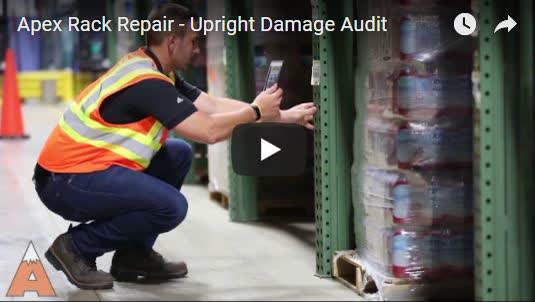
The Apex Rack Repair App: Free DIY Inspection Tool
When something looks wrong between scheduled audits, your team needs a faster path to professional input. The free Apex Rack Repair App, available on iOS and Android, guides users step by step through a structured assessment with prompts for photos and key specifications.
Findings upload directly to Apex PROs for review, and your team receives a comprehensive report, a safety severity assessment, and clear next steps including independent repair or replacement options. The app complements your warehouse safety program and helps your team track rack condition efficiently between professional audits.
The app works best for documenting damage as it appears between scheduled visits. When rack has sustained confirmed impact damage, visible deformation, or compromised anchors, those conditions warrant a direct on-site assessment from Apex PROs so the affected components can be evaluated in person.
Common Causes of Rack Damage in North Carolina Operations
Most rack failures do not happen suddenly. They start with small impacts and missed maintenance that compound over time. Here are the root causes Apex PROs see most consistently:
- Forklift and material handling equipment impacts during loading, unloading, and aisle travel
- In-house reconfigurations completed without professional guidance, leaving racking improperly assembled
- Loose, missing, or improperly installed anchors that leave uprights unsecured
- Missing or insufficient row spacers in back-to-back systems with a height-to-depth ratio of 6:1 or greater
- Overloading beyond rated weight capacity, often due to missing or out of date load capacity plaques
- Corrosion and rust on baseplates and lower uprights, accelerated in humid or coastal facilities
- DIY repairs using non-approved methods and materials that compromise the system's load integrity
Many of these causes are preventable with the right safety infrastructure and maintenance schedule. Apex PROs document root causes during inspections so your team can address maintenance needs and recurring patterns rather than symptoms.
Inspection Frequency: How Often Should North Carolina Facilities Conduct Rack Inspections?
The RMI ANSI MH16.1 standard calls for a minimum of one annual professional inspection. For most North Carolina facilities that is the baseline, though several factors justify more frequent professional audits: high-traffic operations running multiple shifts, heavy loads or dense storage configurations, older rack systems with accumulated wear, and facilities that have experienced prior forklift strikes or equipment impacts.
Post-incident inspections should follow any confirmed forklift strike regardless of where you are in the annual cycle. The OSHA National Emphasis Program, active through 2026, has increased enforcement attention on warehousing operations nationally. Regular inspections with consistent documentation demonstrate that your rack safety program is active and maintained.
Repair vs. Replacement: Making the Right Decision
Some rack damage can be addressed with repair, while other damage calls for component replacement. The decision comes down to the extent of the damage and whether the repair restores the rack to full rated capacity. Repair works best when the damage is isolated, such as a bent beam, a damaged connector, or a dented upright that has not gone out of plumb, and catching damage early can save the cost of replacing a section that could have been repaired. PE-approved repair kits are engineered to restore original rated capacity when damage falls within repairable limits, and this is an OSHA and RMI-accepted approach when properly evaluated and installed.
Replacement is necessary when structural integrity is compromised beyond what a repair kit addresses, when multiple damage points exist in the same bay or column line, or when corrosion has weakened structural members throughout the system. Extensive damage or uncertainty about how a repair interacts with the rack's original engineering can also call for an engineering evaluation, which is identified as a separate scope of work rather than folded into a routine repair. While that decision is being made, the affected bays come out of service, taking that storage space offline until the rack is cleared or repaired. Apex provides independent assessment and expert advice, so the recommendation your team receives reflects what the rack actually needs.
What Happens During an Apex PRO Inspection
The Apex rack inspection and repair process is designed to be thorough without taking your warehouse offline. In most cases, Apex PROs work during normal business hours with no shutdown required, though off-shift scheduling can be arranged. A standard facility typically completes in a few hours, with total time varying by size and system complexity. Minimizing downtime is built into how the inspection is run.
After the inspection, you receive a comprehensive written report with photo documentation, findings organized by severity, and a clear determination: approved to operate, minor repairs needed, or unload and repair before returning to service.
Understanding OSHA & RMI Compliance for Pallet Rack Safety
OSHA does not publish a dedicated pallet rack standard, but rack safety falls within its enforcement scope through the general duty clause and the storage standard at 29 CFR 1910.176(b), which requires storage areas to be maintained safely. Following the RMI ANSI MH16.1 standard, the recognized industry benchmark for rack design, installation, and ongoing maintenance, helps align your operation with accepted industry practice. Compliance also depends on rack design, facility conditions, local code, and how findings are addressed, so inspection documentation supports that effort rather than guaranteeing it on its own.
OSHA National Emphasis Program (2024-2026)
The OSHA National Emphasis Program keeps warehousing operations under added inspection attention. Professional inspections from Apex PROs produce a dated inspection record and completed repair documentation. That record is crucial when an insurer or OSHA inspector requests proof that your rack safety program is active and professionally documented.
Rack Damage Assessment Levels: When to Act
Not all rack damage requires the same response. The three assessment levels Apex PROs use are:
Green (Monitor)
Surface scrapes or paint transfer that do not affect steel geometry. No structural concern. Document the location and note it for the next inspection cycle.
Yellow (Schedule Repair)
Minor dents, missing safety clips, loose hardware, or a single damaged component with no adjacent damage points. The system can remain in service, but repairs should be scheduled promptly.
Red (Immediate Action)
Creased or buckled beams, out-of-plumb uprights exceeding allowable tolerance, unanchored rack, or multiple damage points in the same bay. Unload the affected rack immediately and call for a professional assessment before returning it to service. This takes that storage space offline until the rack is cleared.
When you are uncertain which level applies, that uncertainty itself is the signal to contact Apex PROs.
Complete Repair and Replacement Services
When inspection identifies damage, Apex provides repair and replacement services to bring your system back to rated capacity with structural integrity restored. The scope includes:
- Expert installation of PE-approved repair kits tailored to your rack specifications
- Replacement of damaged components
- Full restoration of original load capacity, which extends the service life of the system
- Documentation that helps confirm the system is safe to operate at rated capacity, supporting your compliance record
Protecting Your Investment: Prevention Strategies
Inspection and repair address damage after it occurs, but the right prevention strategy reduces how often damage happens in the first place. Column protectors and other rack safety accessories absorb equipment impact before it reaches structural components, posted load capacity plaques at every rack location reduce overloading from operator error, and proper aisle width for the equipment in use is one of the most overlooked factors in rack damage frequency.
Operator behavior accounts for most rack impacts, so forklift training keeps your employees safe and addresses the patterns behind the damage. Annual professional inspection, internal audits using the Rack Repair App, and immediate post-incident assessments keep your safety program active, protect productivity by preventing unplanned downtime, and help prevent accidents between professional visits.
To evaluate whether current prevention measures match your traffic patterns and load configurations, request a walk-through during your next scheduled inspection.
Request a Walk-ThroughFrequently Asked Questions About Pallet Rack Inspection in North Carolina
Frequently Asked Questions
RMI and ANSI MH16.1 recommend a minimum of one annual professional inspection as a baseline. How often you inspect beyond that depends on how heavily the rack is used, how often forklifts operate near it, and whether damage has been identified before, so high-traffic facilities or operations with a history of impacts often need more frequent audits. Internal visual checks using the Rack Repair App are a strong practice between professional visits.
Schedule Your North Carolina Rack Inspection with Apex
Apex PROs, certified through a program approved by SEIZMIC Engineering, serve North Carolina warehouses with professional inspections, damage assessments, and repair services from the Carolinas team based in Charlotte and Hickory. Work in the state is backed by Southeast project coverage and Apex's Licensed General Contractor credential in the region.
Next steps for North Carolina facilities: schedule a rack inspection or consultation at (630) 957-4020, download the Apex Rack Repair App on iOS or Android for documented self-assessment between professional visits, or talk to an Apex representative to submit a site visit request.